Global Capability Centers (GCCs) have evolved beyond traditional support functions to become strategic hubs for technology, engineering, analytics, research and business innovation. As organizations expand their GCC operations, hiring the right talent becomes essential for achieving business objectives and building high-performing teams.
However, GCC hiring presents unique challenges, including competition for specialized skills, evolving technology requirements, lengthy recruitment processes and the need to evaluate candidates consistently across multiple roles.
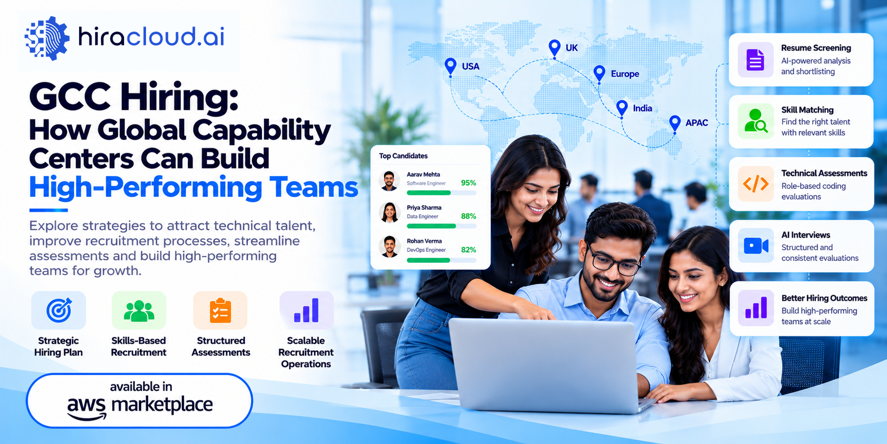
A structured GCC recruitment strategy can help organizations identify relevant talent, improve candidate evaluation and build teams aligned with long-term business goals. AI-enabled recruitment tools can further support this process by connecting resume screening, skill matching, interviews and technical assessments within a coordinated hiring workflow.
Explore the HiraCloud AI Platform to see how intelligent automation and connected workflows empower enterprise technical recruitment.
What Is GCC Hiring?
GCC hiring refers to the recruitment of employees for Global Capability Centers established by multinational organizations to manage and develop strategic business functions.
These centers may support software engineering, cybersecurity, cloud computing, data analytics, finance, research and development, and other specialized operations.
Unlike recruitment for individual support roles, GCC talent acquisition often involves building teams with specific technical competencies, domain knowledge and the ability to collaborate across global business functions.
An effective GCC hiring strategy aligns workforce planning, skills assessment, candidate experience and recruitment operations with the organization's long-term objectives.
Why Is GCC Hiring Important for Business Growth?
GCCs depend on skilled professionals to deliver specialized services, develop new capabilities and support global operations.
A strong recruitment approach helps organizations:
Build specialized teams
Recruit professionals with the technical and domain-specific skills required for business-critical projects.
Support innovation
Identify talent capable of developing products, improving processes and adopting emerging technologies.
Scale operations
Establish repeatable hiring processes as new teams and business functions are introduced.
Improve team performance
Evaluate candidates against consistent, role-specific competencies.
Strengthen long-term capabilities
Build teams that support evolving business priorities rather than focusing only on immediate vacancies.
Achieving these outcomes requires more than filling positions quickly. GCCs need a structured approach to identifying, assessing and selecting suitable candidates.
Key GCC Recruitment Challenges
Competition for Specialized Talent
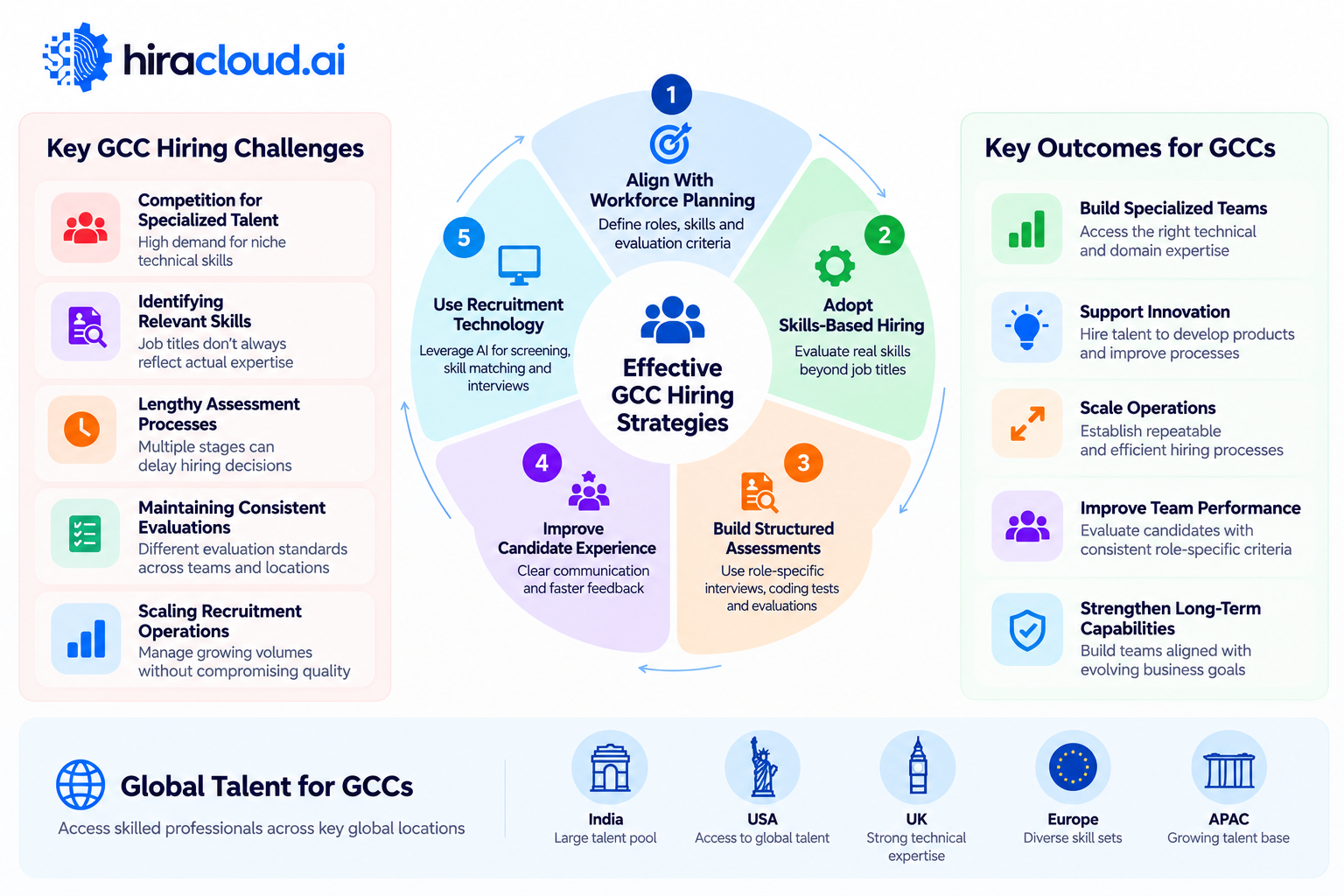
GCCs frequently recruit for roles involving cloud engineering, artificial intelligence, cybersecurity, software development and data analytics. Competition for these skills can make it difficult to identify suitable candidates within expected timelines.
Identifying Relevant Skills
Resumes may contain similar job titles while representing different levels of technical expertise. Recruiters need to evaluate actual skills, relevant experience and alignment with job requirements rather than relying exclusively on keywords.
Lengthy Assessment Processes
Technical hiring may involve resume screening, recruiter discussions, multiple interviews and coding assessments. Poor coordination between these stages can delay decisions and increase administrative work.
Maintaining Consistent Evaluations
Different recruiters and interviewers may apply different evaluation standards. Without structured criteria, comparing candidates across teams and locations becomes more difficult.
Scaling Recruitment Operations
As GCCs expand, recruitment teams must manage more vacancies, applicants and assessments without compromising evaluation quality or candidate experience.
Addressing these challenges requires clear hiring criteria, coordinated recruitment workflows and reliable assessment methods.
Effective GCC Recruitment Strategies
Align Hiring With Workforce Planning
Begin by identifying the roles, competencies and experience levels required to support business objectives. Work with technical leaders and hiring managers to define essential skills, responsibilities and evaluation criteria before publishing vacancies.
Adopt Skills-Based Recruitment
Look beyond job titles and qualifications to evaluate candidates against relevant technical skills, problem-solving abilities and practical capabilities. Skills-based evaluation helps teams identify qualified candidates whose resumes may not reflect conventional career paths.
Build Structured Assessment Processes
Establish consistent evaluation stages for each role. Depending on the position, this may include resume screening, initial technical discussions, coding assessments and structured interviews. Using defined assessment criteria helps interviewers evaluate candidates consistently.
Improve Candidate Experience
Communicate assessment requirements clearly, provide timely updates and reduce unnecessary steps in the recruitment process. A transparent hiring experience reflects positively on the organization and encourages candidate engagement.
Use Recruitment Technology Strategically
AI-enabled recruitment platforms can support resume analysis, candidate-to-job skill matching, interview coordination and coding assessments. Connecting these activities within a unified workflow helps teams review candidate information more efficiently.
Technology should support recruiters rather than replace human judgment in consequential hiring decisions.
How AI Is Transforming GCC Talent Acquisition
AI is helping recruitment teams organize candidate information and coordinate selected hiring stages.
For GCCs recruiting across multiple technical roles, connected recruitment workflows can support:
- Resume and job description analysis: Organize candidate experience, qualifications and competencies alongside role requirements.
- Bidirectional skill matching: Compare candidate capabilities with job requirements to support shortlist decisions.
- AI-powered interviews: Support structured interviews and organize candidate responses for review.
- Technical assessments: Incorporate practical coding evaluations into the hiring workflow.
- Consolidated evaluation: Bring relevant information from different assessment stages together for recruiter review.
Agentic AI hiring extends this approach by coordinating permitted recruitment activities toward defined objectives. The level of autonomy depends on the platform, integrations, permissions and configured workflows.
How HiraCloud AI Supports GCC Hiring
HiraCloud AI is an agentic hiring cloud designed for Global Capability Centers, Offshore Delivery Centers and enterprise technical hiring teams.
Its connected capabilities support candidate intake, assessment and evaluation within one hiring environment. These include:
- Resume and job description intake: Organize candidate information alongside job requirements.
- Bidirectional skill matching: Connect candidate capabilities with the skills required for a role.
- L1 and L2 AI-powered video interviews: Support structured candidate interviews.
- Proctored coding assessments: Evaluate practical technical skills as part of the recruitment process.
- Sentinel integrity monitoring: Provide additional assessment integrity signals, including gaze tracking, lip-sync validation, liveness detection and deepfake signals.
- Consolidated candidate evaluation: Bring relevant information together to support recruiter review.
By connecting these activities, HiraCloud AI helps recruitment teams coordinate technical assessments and review candidate information within a unified workflow. Explore the HiraCloud AI product workflow to understand how candidate intake, skill matching, AI interviews, coding assessments and evaluation connect across the hiring process.
Best Practices for Improving GCC Recruitment Outcomes
To strengthen GCC recruitment, organizations should establish clear performance measures and regularly review their hiring processes.
- Measure recruitment performance: Track relevant metrics such as time-to-hire, candidate completion rates, assessment turnaround time and recruiter administrative workload.
- Review assessment quality: Ensure that evaluation criteria remain relevant to the role and consistently applied across candidates.
- Protect candidate information: Review data access controls, retention practices, security safeguards and applicable privacy obligations.
- Maintain human oversight: Recruiters and hiring managers should review assessment results, investigate discrepancies and make final hiring decisions.
- Improve processes continuously: Use recruitment data and candidate feedback to identify delays, unnecessary steps and opportunities to improve the hiring experience.
These practices help organizations evaluate whether their recruitment strategies are delivering meaningful operational improvements.
Frequently Asked Questions
What is GCC hiring?
GCC hiring is the recruitment of professionals for Global Capability Centers that support functions such as technology, engineering, analytics, research and business operations for multinational organizations.
What are the biggest GCC recruitment challenges?
Common challenges include competition for specialized talent, skill shortages, lengthy assessment processes, inconsistent candidate evaluation and the need to scale recruitment operations.
How can GCCs improve talent acquisition?
GCCs can improve talent acquisition through workforce planning, skills-based recruitment, structured assessments, better candidate communication and appropriate recruitment technology.
How can AI help with GCC hiring?
AI can support resume analysis, skill matching, structured interviews, technical assessments and consolidated candidate evaluation. Recruiters should retain oversight of important hiring decisions.
How can GCCs assess technical candidates effectively?
GCCs can combine role-specific skill criteria, structured interviews and practical coding assessments to evaluate candidates using relevant evidence.
Conclusion
Building high-performing teams requires GCCs to align recruitment strategies with business objectives, identify relevant technical skills and maintain consistent assessment standards.
Structured GCC recruitment, skills-based evaluation and connected hiring workflows can help organizations coordinate recruitment activities while supporting informed decisions.
HiraCloud AI brings resume and job description intake, bidirectional skill matching, AI-powered interviews, proctored coding assessments, integrity monitoring and candidate evaluation together within one hiring environment.
Explore HiraCloud AI on AWS Marketplace
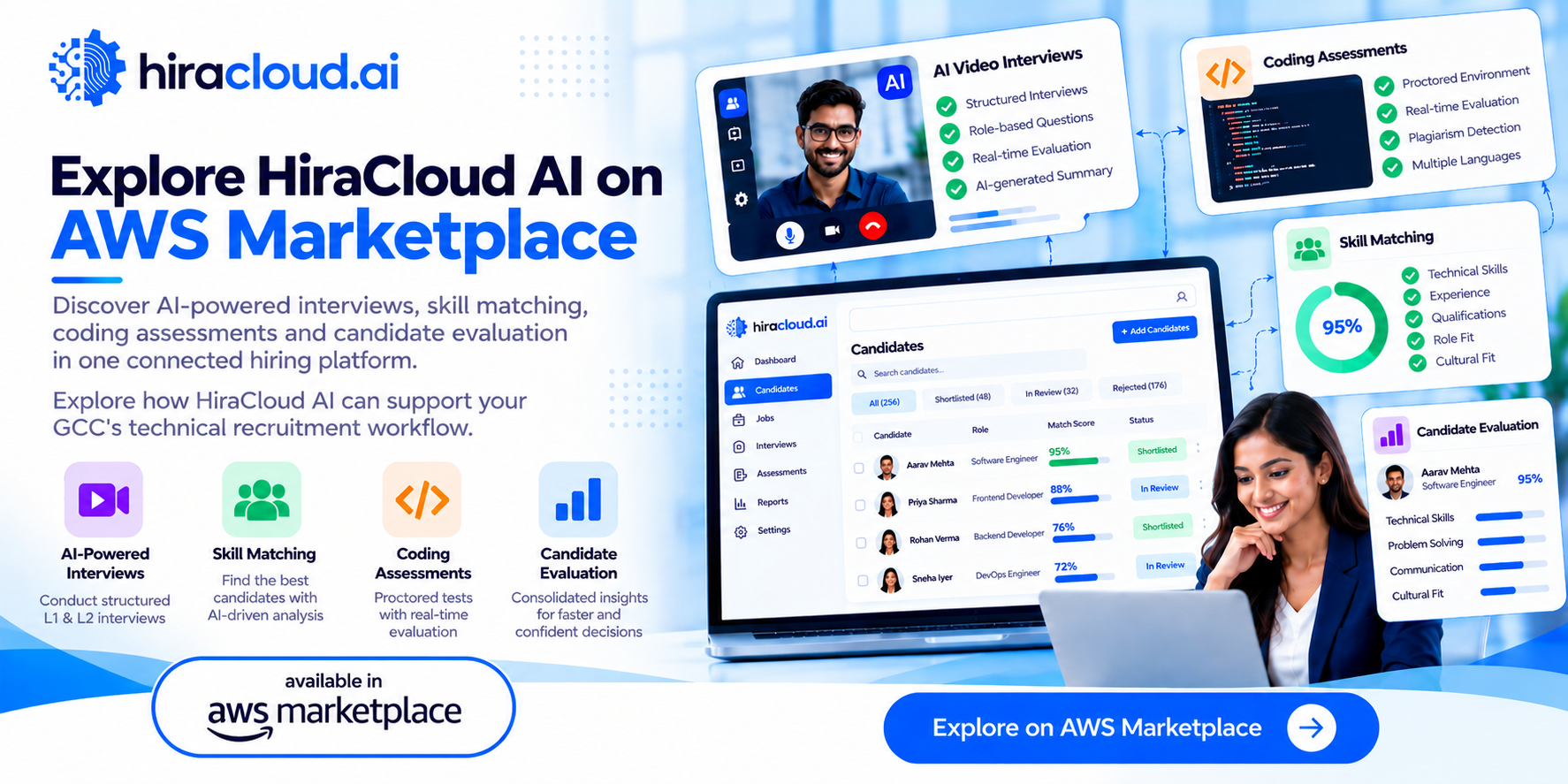
Discover AI-powered interviews, skill matching, coding assessments and candidate evaluation in one connected hiring platform. Explore how HiraCloud AI can support your GCC's technical recruitment workflow.