Identifying qualified candidates is one of the biggest challenges in modern recruitment. As organizations receive more applications across multiple roles, recruiters must review resumes, compare skills, verify qualifications and shortlist candidates while maintaining a consistent hiring process.
Manual screening can become time-consuming, particularly for enterprises, technology companies, Global Capability Centers (GCCs), Offshore Delivery Centers (ODCs) and IT services organizations hiring for specialized technical roles.
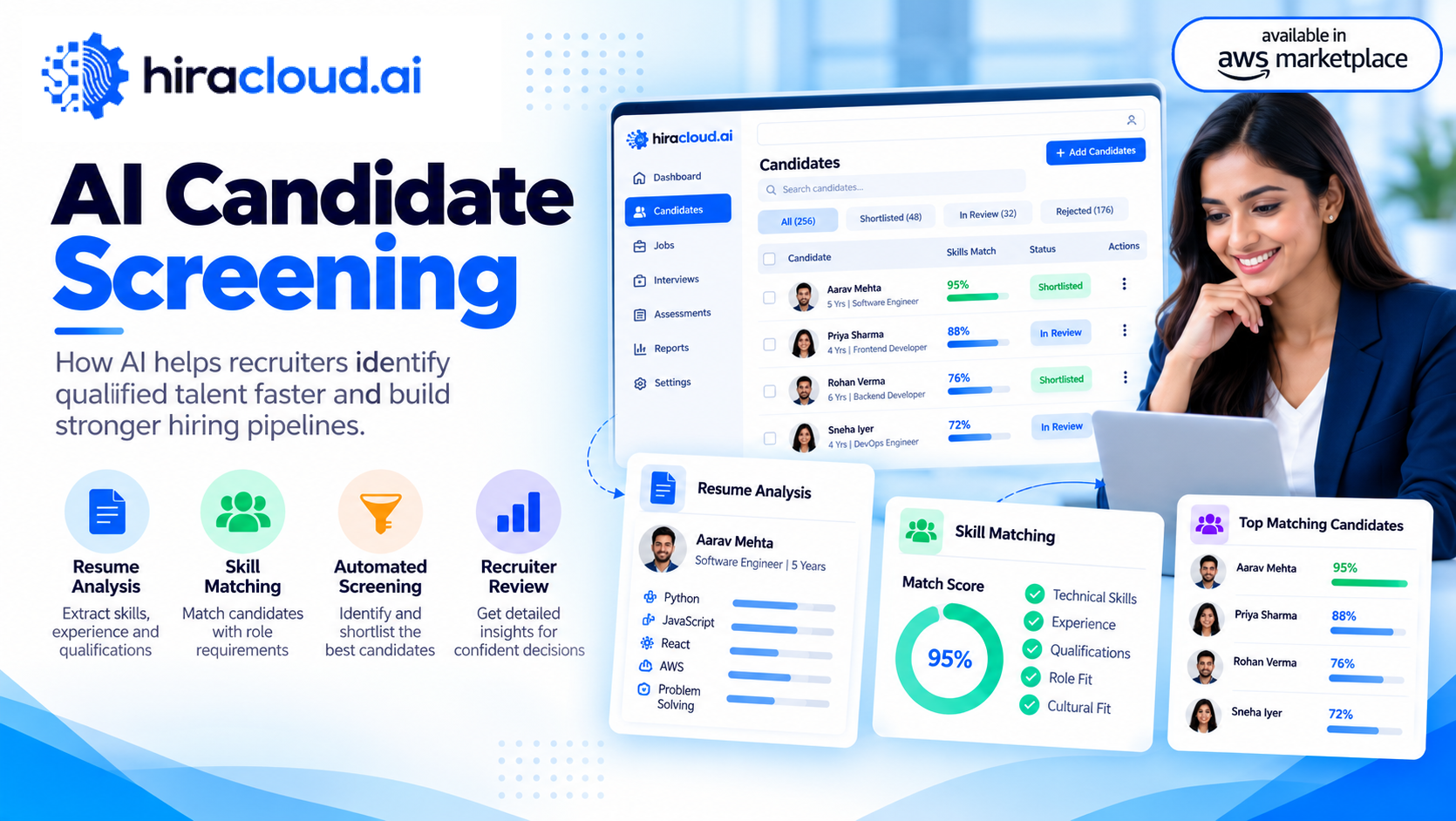
AI candidate screening uses artificial intelligence to help recruiters analyze candidate information, identify relevant skills and compare applicant profiles against job requirements. Depending on the platform, these capabilities can support resume analysis, candidate matching, initial screening and preparation for subsequent interviews and assessments.
Automated candidate screening can help organize recruitment workflows and reduce repetitive administrative tasks. However, effective screening still requires relevant job criteria, reliable candidate information and human oversight.
HiraCloud AI connects resume and job description intake with bidirectional skill matching, AI-powered interviews, technical assessments and candidate evaluation to support a more connected hiring workflow. Explore the HiraCloud AI Platform.
What Is AI Candidate Screening?
AI candidate screening is the use of artificial intelligence to analyze candidate information and help recruiters identify applicants whose qualifications, experience and skills align with a particular role.
An AI screening tool may process resumes, interpret job descriptions, identify relevant competencies and organize candidate profiles for recruiter review. More advanced recruitment platforms can connect screening with interviews, technical assessments and consolidated candidate evaluation.
Common AI applicant screening capabilities include:
- Resume and job description analysis
- Skills and experience identification
- Candidate-to-job matching
- Candidate profile comparison
- Initial screening support
- Interview and assessment workflow integration
- Candidate information summaries for recruiters
The exact capabilities vary by provider. AI screening should support recruitment decisions rather than automatically determine which candidates deserve consideration without appropriate review.
How Does Automated Candidate Screening Work?
Automated candidate screening typically follows several stages, depending on the platform and the organization's recruitment process.
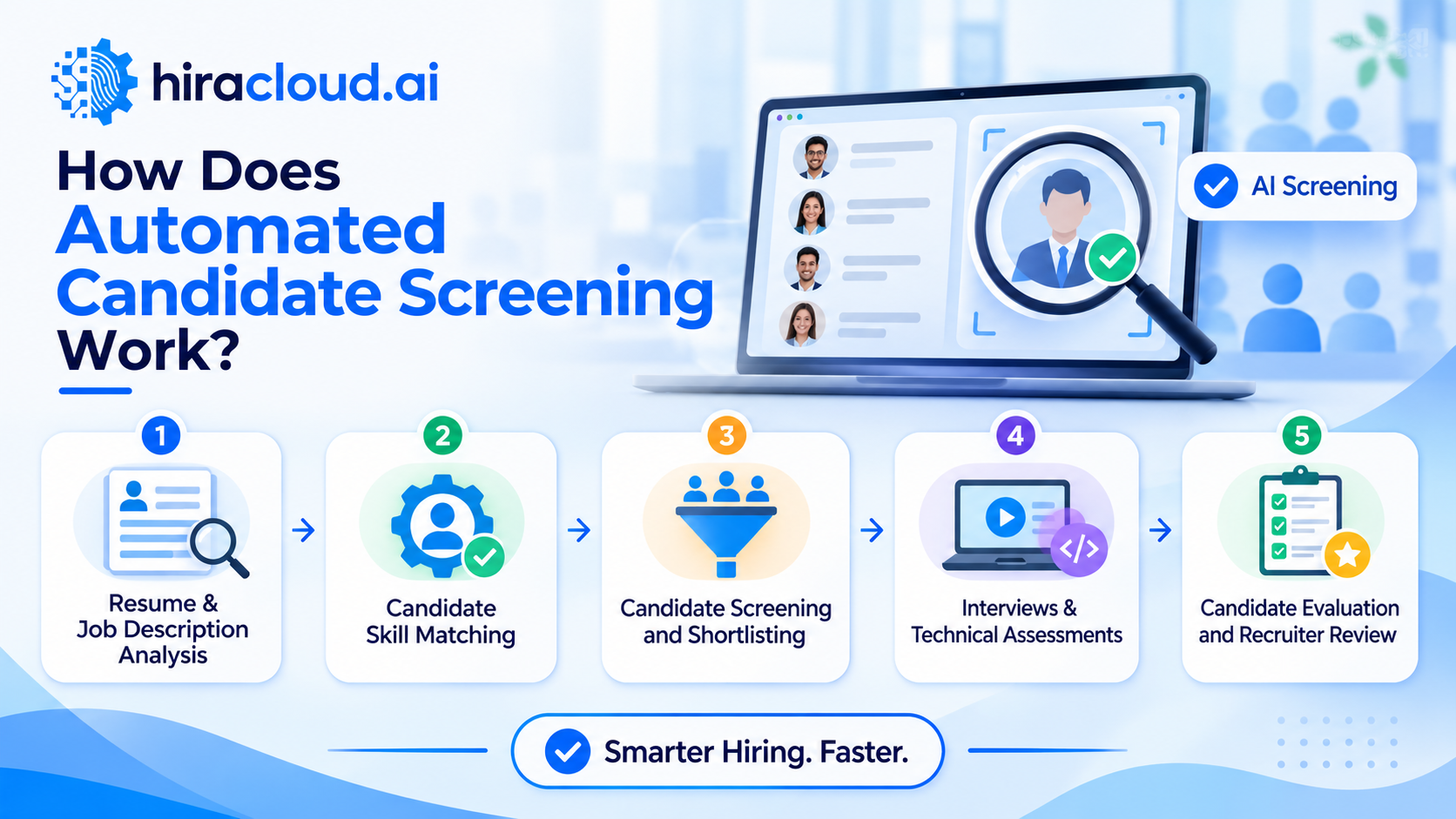
1. Resume and Job Description Analysis
The process begins with candidate resumes and the job description. AI technology can analyze resumes to identify relevant qualifications, skills, experience and other information associated with a role.
It can also analyze job descriptions to identify required competencies and experience. This creates a basis for comparing applicant profiles with the requirements established by the hiring team.
HiraCloud AI supports resume and job description intake as part of its connected hiring workflow.
2. Candidate Skill Matching
After analyzing candidate and job information, the platform can help recruiters identify potential matches between applicant skills and role requirements.
Skill matching can consider technical competencies, relevant experience and configured screening criteria. This helps recruiters prioritize profiles for further review.
HiraCloud AI supports bidirectional skill matching, connecting candidate capabilities with job requirements before subsequent interview and assessment stages.
3. Candidate Screening and Shortlisting
An AI applicant screening system can organize candidate information and help recruiters identify profiles that meet defined criteria.
Recruiters can use the resulting information to prioritize applications for further evaluation. Screening criteria should be relevant to the role and applied consistently.
Human review remains important because resumes may contain incomplete information, transferable skills or qualifications that automated systems do not fully recognize.
4. Interviews and Technical Assessments
Candidate screening is often only the beginning of the hiring process. Shortlisted applicants may need to complete structured interviews, coding tests or other role-specific assessments.
An integrated AI recruitment platform can connect screening with later stages of hiring. Learn more about how AI interviews transform the modern hiring process and support structured candidate evaluation.
HiraCloud AI supports L1 and L2 AI-powered video interviews and proctored coding assessments within its connected hiring workflow.
5. Candidate Evaluation and Recruiter Review
The final stage involves reviewing the available candidate information and determining the appropriate next steps.
Depending on the platform, recruiters may be able to review skill-matching information, interview responses, transcripts and technical assessment results together.
HiraCloud AI brings interview and assessment information into a connected hiring environment to support recruiter review and informed hiring decisions.
To understand how these capabilities work together, explore the HiraCloud AI Product Workflow, which connects candidate intake, skill matching, AI interviews, technical assessments and candidate evaluation within a unified hiring process.
Key Features of an AI Screening Tool
When evaluating an AI screening tool, recruiters should focus on features that support their actual hiring requirements.
Resume Parsing and Analysis
Resume analysis helps organize candidate information, including skills, qualifications, experience and employment history. The quality of the results depends on resume format, data quality and the relevance of the screening criteria.
Job Description and Skill Matching
Skill matching compares candidate capabilities with role requirements. This can help recruiters identify relevant profiles without relying exclusively on job titles or keyword matches.
Candidate Profile Comparison
Some platforms help recruiters organize candidate information against predefined requirements. These comparisons should support structured review rather than treat an automated score as a definitive measure of candidate quality.
Recruitment Workflow Integration
An AI screening tool can be more useful when its outputs connect with interviews, assessments and candidate evaluation. Integrated workflows can reduce the need to transfer information manually between separate applications.
Human Oversight and Data Governance
Organizations should understand how candidate data is processed, stored and accessed. Screening systems should support transparency, appropriate privacy controls, relevant criteria and human review of consequential hiring decisions.
What Are the Benefits of AI Applicant Screening?
AI applicant screening can provide operational benefits when implemented appropriately and aligned with recruitment requirements.
More Efficient Application Review
AI-assisted resume analysis can help recruiters organize large volumes of candidate information and identify profiles for further consideration. Actual time savings depend on application volume, system configuration and the amount of manual review required.
More Structured Screening
Using predefined, job-related criteria can help recruiters evaluate applications more consistently. Structured screening does not eliminate bias automatically, so organizations should monitor outcomes and review the suitability of their criteria.
Better Skills-Based Matching
AI candidate screening can help identify relevant competencies that may not be immediately apparent from job titles alone. This can support skills-based recruitment when matching criteria are accurate and appropriate for the role.
Reduced Administrative Work
Automating selected screening activities can reduce repetitive tasks associated with organizing applications and comparing candidate information. Recruiters can then devote more attention to candidate engagement and evaluation.
Connected Hiring Workflows
When screening information flows into interviews and assessments, recruitment teams can review candidate progress with less manual coordination. HiraCloud AI connects screening-related intake and skill matching with interviews, coding assessments and candidate evaluation.
AI Candidate Screening vs. Manual Screening
AI candidate screening and manual screening serve the same broad purpose: identifying applicants who may meet a role's requirements. They differ in how candidate information is processed and organized.
| Area | Manual screening | AI-assisted screening |
|---|---|---|
| Resume review | Recruiters examine applications individually | AI can help extract and organize candidate information |
| Skill matching | Recruiters compare skills with job criteria | AI can assist with candidate-to-job matching |
| Application volume | Review capacity depends heavily on available staff | Automation may help manage larger application volumes |
| Consistency | Depends on screening procedures and reviewer practices | Configured criteria can support more structured comparisons |
| Human judgment | Recruiters interpret candidate information | Recruiters remain responsible for reviewing results and decisions |
AI screening is not automatically more accurate or fair than manual screening. Results depend on data quality, system design, job-related criteria and appropriate human oversight.
How to Choose the Right AI Screening Tool
Before implementing an AI screening tool, organizations should evaluate the following factors:
Screening capabilities: Check whether the platform supports resume analysis, job description interpretation and relevant skill matching.
Assessment integration: Determine whether screening connects with interviews, coding assessments and subsequent candidate evaluation.
Transparency: Understand how candidate information is analyzed and how screening results are presented to recruiters.
Fairness and oversight: Review how the platform supports consistent criteria, bias monitoring and human decision-making.
Privacy and security: Examine how resumes, candidate details and assessment records are processed, stored and accessed.
Measurable outcomes: Establish baseline metrics such as screening time, candidate completion rates and recruiter workload before evaluating the impact of automation.
The right solution should fit the organization's recruitment process rather than simply offer the largest number of AI features.
Frequently Asked Questions
What is AI candidate screening?
AI candidate screening uses artificial intelligence to analyze candidate information and help recruiters identify applicants whose skills, qualifications and experience align with job requirements.
How does automated candidate screening work?
Automated candidate screening typically analyzes resumes and job descriptions, compares candidate information against configured criteria and organizes profiles for recruiter review. Some platforms connect screening with interviews and technical assessments.
What is an AI screening tool?
An AI screening tool is software that uses AI to assist with activities such as resume analysis, candidate matching and initial applicant review. Its capabilities vary by provider.
Can AI applicant screening replace recruiters?
No. AI can assist with repetitive screening activities, but recruiters remain important for interpreting results, evaluating context, engaging candidates and making informed hiring decisions.
Can AI candidate screening introduce bias?
Yes. AI screening may reproduce or amplify biases present in its data, design or selection criteria. Organizations should use job-related criteria, monitor outcomes and maintain appropriate human oversight.
How does HiraCloud AI support candidate screening?
HiraCloud AI connects resume and job description intake with bidirectional skill matching, AI-powered interviews, proctored coding assessments, integrity monitoring and consolidated candidate evaluation.
Conclusion
AI candidate screening helps recruiters organize applications, identify relevant skills and compare candidate profiles against job requirements. When combined with clear criteria and human oversight, automated candidate screening can support more structured and coordinated recruitment workflows.
For organizations hiring technical talent at scale, connecting screening with interviews, coding assessments and candidate evaluation can make it easier to review relevant evidence across the hiring process.
HiraCloud AI brings these capabilities together through an agentic hiring cloud designed for GCCs, ODCs and enterprise technical hiring teams.
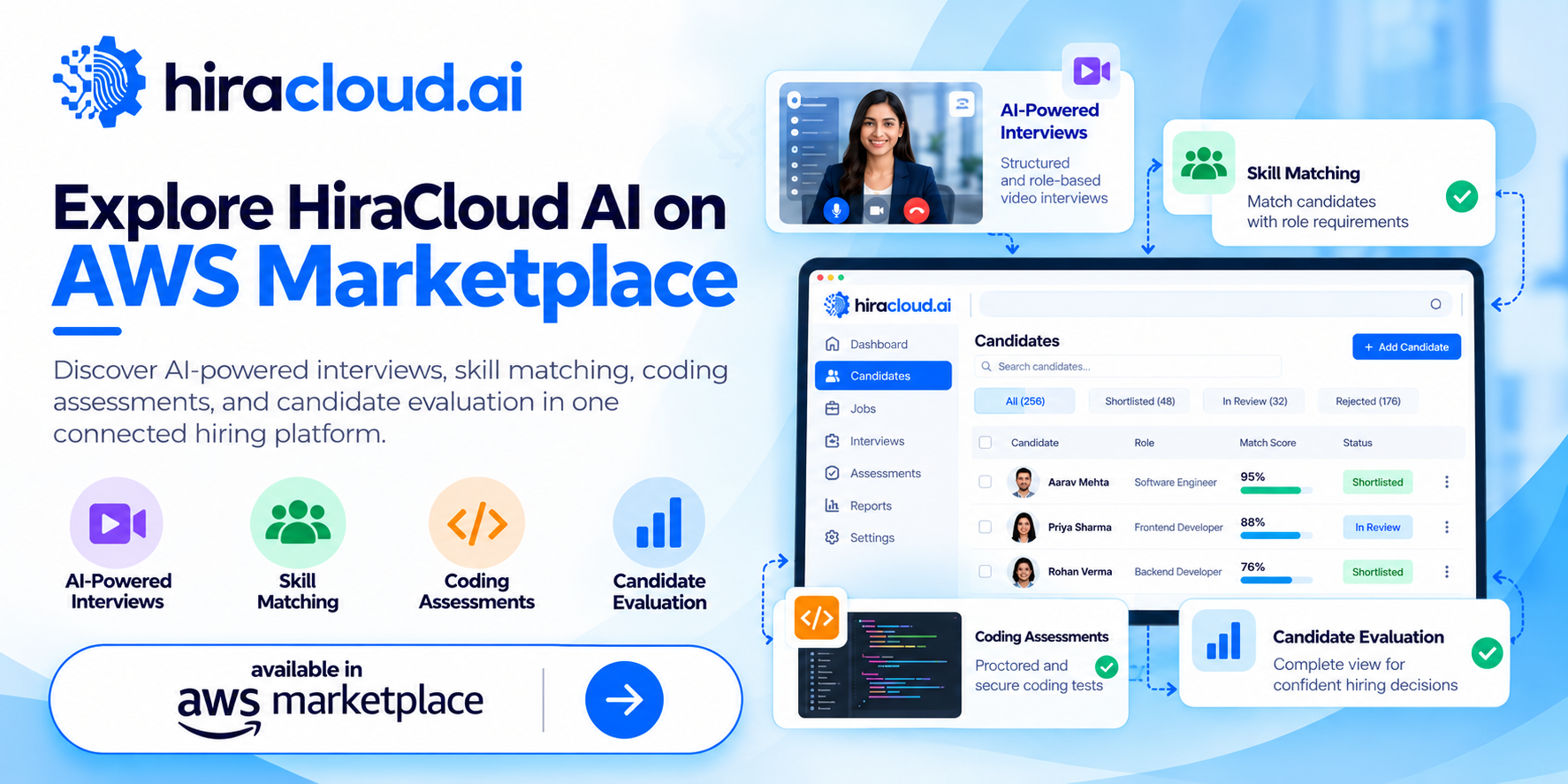
Explore HiraCloud AI on AWS Marketplace
Discover AI-powered interviews, skill matching, coding assessments, and candidate evaluation in one connected hiring platform.