Hiring teams are under increasing pressure to identify qualified candidates, evaluate technical skills and manage growing recruitment volumes without compromising hiring quality. Traditional recruitment processes often involve separate tools for resume screening, candidate interviews, coding assessments, interview integrity and candidate evaluation.
When these activities operate independently, recruiters may need to switch between multiple platforms, coordinate manual handoffs and consolidate assessment information from different sources. This can make recruitment workflows more difficult to manage, particularly for enterprises, technology companies, Global Capability Centers (GCCs), Offshore Delivery Centers (ODCs) and IT services organizations.
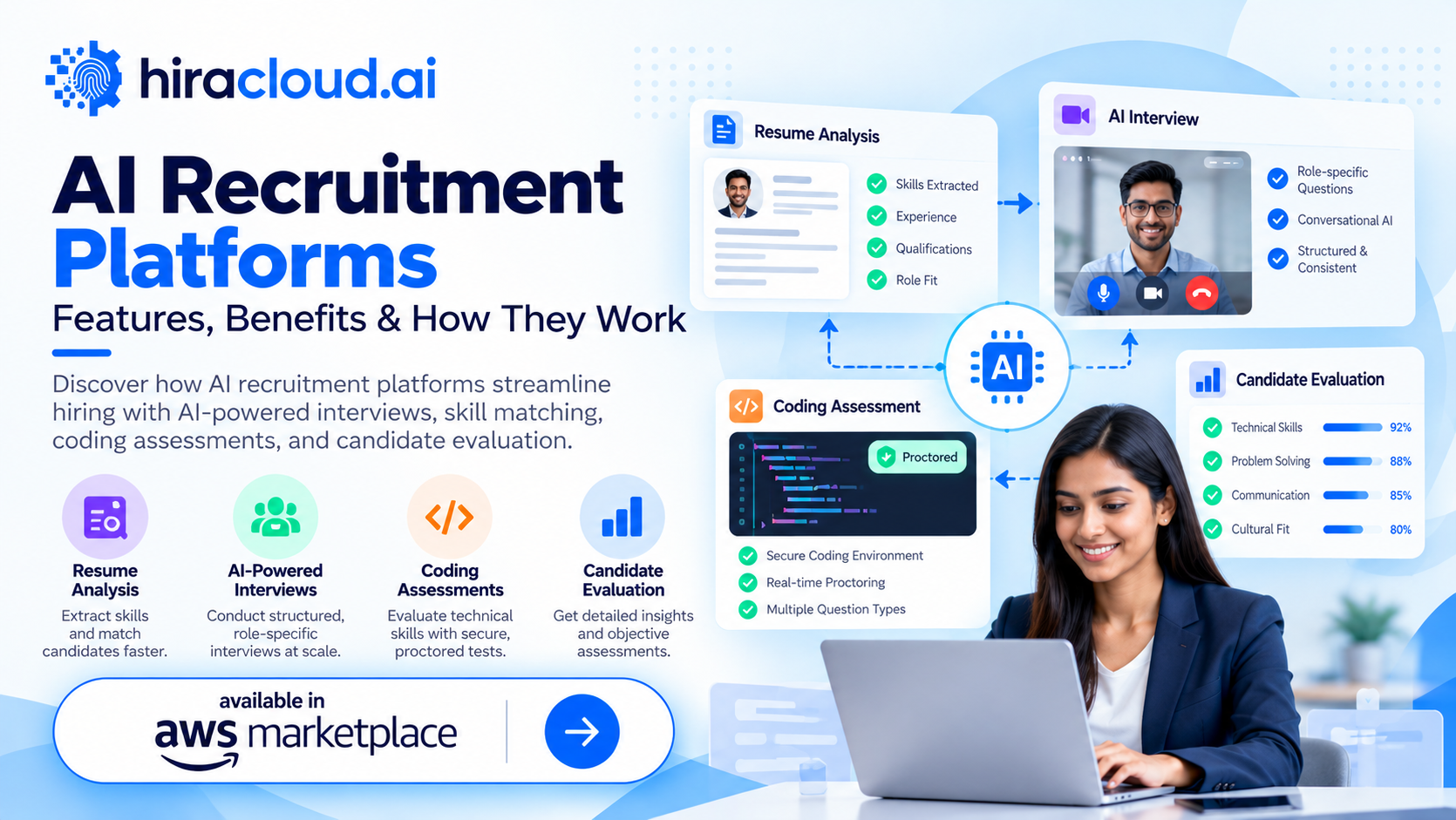
An AI recruitment platform helps organizations use artificial intelligence to support and automate different stages of the hiring process. Depending on its capabilities, an AI hiring platform can connect candidate intake, skill matching, AI-powered interviews, technical assessments and candidate evaluation within a coordinated workflow.
Modern AI recruitment technology is also moving beyond isolated automation toward integrated and agentic hiring workflows that help coordinate multiple recruitment activities. For organizations hiring at scale, the focus is no longer just on automating individual tasks. It is about creating a connected hiring process that supports recruiters, improves assessment consistency and enables informed human decision-making.
HiraCloud AI brings these capabilities together through an agentic hiring cloud designed for GCCs, ODCs and enterprise technical hiring teams. Explore the HiraCloud AI Platform.
What Is an AI Recruitment Platform?
An AI recruitment platform is software that uses artificial intelligence to support recruitment activities such as resume analysis, candidate screening, skill matching, interviews, technical assessments and candidate evaluation. Depending on the platform, these capabilities may operate as individual features or as connected stages of an end-to-end hiring workflow.
An AI-powered recruitment platform may include:
- Resume and job description analysis
- Candidate-to-job skill matching
- Automated candidate screening
- Conversational AI video interviews
- Technical and coding assessments
- Interview transcripts and assessment reports
- Remote assessment integrity monitoring
- Consolidated candidate evaluation
- Recruiter review and decision support
The objective is to help recruitment teams organize candidate information, reduce repetitive administrative activities and evaluate applicants through more structured processes. AI recruitment platforms do not necessarily replace recruiters or hiring managers. Human oversight remains important for interpreting assessment results, reviewing candidates fairly and making final hiring decisions.
For enterprises with complex recruitment requirements, a connected AI recruitment platform can provide a common environment for managing multiple stages of candidate evaluation.
How Does an AI Recruitment Platform Work?
An AI recruitment platform can connect several recruitment stages, from receiving candidate applications to preparing evaluation information for recruiter review. The exact workflow depends on the platform, its integrations and the organization's recruitment requirements.
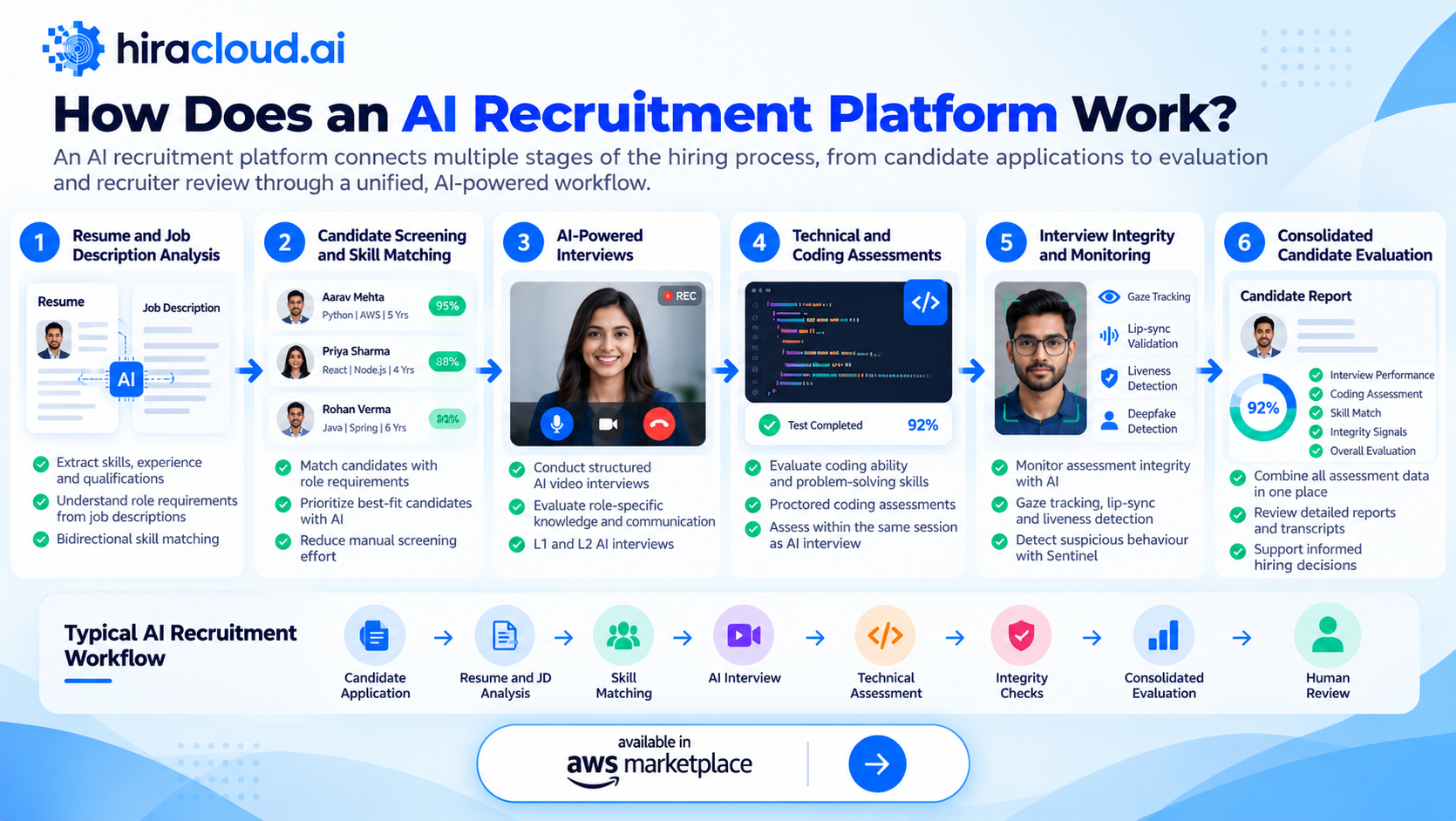
Resume and Job Description Analysis: The process begins with candidate resumes and job descriptions. AI recruitment technology can analyze resumes to identify skills, qualifications, professional experience and other relevant information. It can also interpret job descriptions to identify the competencies and requirements associated with a role. HiraCloud AI supports resume and job description intake with bidirectional skill matching, connecting candidate capabilities with role requirements before the interview stage.
Candidate Screening and Skill Matching: Once candidate information has been analyzed, the platform can help identify profiles that align with the requirements of a particular role. Skill matching can consider relevant technical competencies, experience and other configured criteria. Recruiters can use these insights to prioritize candidates for further assessment with job-related criteria, bias review, and appropriate human oversight.
AI-Powered Interviews: AI-powered interviews can support structured candidate screening by asking configured questions, capturing responses and organizing interview information for review. HiraCloud AI supports L1 and L2 AI-powered video interviews within its connected hiring workflow. For a deeper explanation of interview formats and use cases, read our guide to AI interviews and how they transform modern hiring.
Technical and Coding Assessments: Technical recruitment often requires more than reviewing a resume or conducting a preliminary interview. For software engineering and technical positions, recruitment teams must evaluate practical coding ability and problem-solving skills. HiraCloud AI integrates proctored coding assessments into its hiring workflow, including the ability to conduct coding assessments within the same session as an AI video interview.
Interview Integrity and Assessment Monitoring: Remote interviews and online assessments introduce questions about candidate identity and assessment integrity. HiraCloud AI's Sentinel integrity layer includes gaze tracking, lip-sync validation, liveness detection and deepfake detection. These signals provide additional context for review and are verified by human reviewers.
Consolidated Candidate Evaluation: The final stage brings together the available candidate assessment information into one coherent environment. HiraCloud AI organizes interview responses, transcripts, coding performance, skill-matching data and relevant integrity signals into a single pane of glass, eliminating manual consolidation across siloed systems.
Explore the HiraCloud AI Hiring Workflow.
Key Features of an AI Recruitment Platform
The features available in an AI recruitment platform vary by provider. Organizations should evaluate whether the platform supports their actual hiring workflow rather than choosing a solution based on a single AI capability:
- AI Resume Screening: Organizes candidate information and identifies relevant qualifications, skills, and experience against role specifications.
- Bidirectional Skill Matching: Considers the mutual relationship between role requirements and candidate experience, illuminating alignment before interviews begin.
- Conversational AI Interviews: Conducts structured initial screening through role-specific questions and captured candidate video responses.
- Technical and Coding Assessments: Supplies practical evidence of hands-on coding capability, integrated seamlessly into the interview session.
- Interview Integrity Controls: Provides passive monitoring signals including gaze-tracking, lip-sync checks, and liveness verification.
- Consolidated Evaluation Reports: Assembles transcripts, scores, and integrity signals into a standardized format for recruiter and hiring manager review.
- Connected Recruitment Workflows: Unifies fragmented steps across candidate intake, assessment, and review into one cohesive runtime environment.
- Human Oversight and Data Governance: Enforces role-based access control, strict privacy compliance, and human sign-off on all hiring decisions.
What Are the Benefits of AI Recruitment Platforms?
AI recruitment platforms provide operational advantages when capabilities align with recruitment needs and are implemented with appropriate human oversight:
Support for High-Volume Candidate Screening: Helps teams process large applicant pools consistently without burning hundreds of recruiter hours on repetitive initial screenings.
More Structured Candidate Evaluation: Predefined job-related questions and consistent criteria enable fair, comparable assessments across all applicants.
Reduced Repetitive Administrative Work: Automates scheduling, data transfers, and report generation so recruiters can focus on candidate engagement and decision-making.
Better Coordination Across Recruitment Stages: Shared data between screening, interviews, and assessments gives hiring managers immediate visibility into the complete candidate journey.
Support for Technical Hiring: Combines resume parsing, video screening, and proctored coding assessments into a single session for technical roles.
Greater Operational Scalability: Adapts seamlessly to fluctuating hiring demands across business units, geographies, and roles.
More Organized Recruitment Information: Centralizes transcripts, scores, and evidence for transparent audits, stakeholder collaboration, and compliance.
AI Recruitment Platform vs. Traditional Recruitment Software
Traditional recruitment software and AI recruitment platforms can overlap in their capabilities. The differences depend on the products being compared, so organizations should evaluate actual features rather than relying on product labels:
| Capability | Traditional or fragmented recruitment workflow | Connected AI recruitment platform |
|---|---|---|
| Resume screening | May involve manual review or separate screening tools | Can support AI-assisted resume analysis |
| Skill matching | May rely on manual comparison or individual tools | Can connect candidate skills with job requirements |
| Initial interviews | Often require recruiter scheduling and coordination | May support structured AI-powered interviews |
| Technical assessments | May operate in a separate assessment application | Can integrate assessments into the hiring workflow |
| Assessment information | May be distributed across multiple systems | Can consolidate available assessment information |
| Integrity monitoring | May require a separate tool or procedure | May provide integrated integrity controls |
| Recruiter involvement | Required for coordination, assessment and decisions | Remains important for review, judgment and decisions |
| Workflow management | May require manual handoffs between stages | Can coordinate multiple stages within one environment |
A traditional applicant tracking system (ATS) may already provide automation, integrations and AI features. An AI recruitment platform should therefore be evaluated on its specific capabilities, workflow coverage and integration options rather than assumed to be a complete replacement for an ATS.
Automated Hiring Platform vs. Individual AI Recruitment Tools
Some organizations adopt separate applications for resume screening, interviews, coding assessments, proctoring and candidate evaluation. This approach can work, but it introduces coordination requirements when tools do not share information effectively:
Fragmented workflow: Resume Screening → Interview Tool → Coding Platform → Integrity Monitoring → Recruiter Review
The main distinction is the degree of workflow integration. Individual tools serve point needs; a connected platform coordinates the entire assessment sequence in one shared environment.
What Is an Agentic AI Hiring Platform?
An agentic AI hiring platform aims to coordinate multiple recruitment activities rather than automate only one isolated task. While a standalone tool conducts an interview, an agentic hiring workflow coordinates the progression from candidate intake and skill matching through coding assessments, integrity monitoring, and consolidated evaluation.
HiraCloud AI is positioned as an agentic hiring cloud for GCCs and ODCs, bringing together resume and job description intake, bidirectional skill matching, conversational AI interviews, proctored coding assessments, Sentinel integrity monitoring and consolidated evaluation.
AI Recruitment Platforms for GCCs and ODCs
Global Capability Centers and Offshore Delivery Centers recruit heavily across technical roles, requiring tight coordination between recruiters, hiring managers, and senior architects. Key use cases include:
- Software engineering and cloud architecture recruitment
- Integrated technical and hands-on coding assessments
- High-volume candidate screening without SME scheduling delays
- Distributed recruitment across international delivery hubs
- Multi-stage technical evaluation with consistent scoring
- Coordinated candidate assessment across hiring stakeholders
Organizations can also explore our analysis on how agentic AI transforms high-volume GCC hiring to understand how connected AI workflows support enterprise recruitment operations.
How to Choose the Right AI Recruitment Platform
Use the following checklist to evaluate whether a platform fits your organization's requirements:
Define Your Recruitment Requirements: Identify target roles, hiring volumes, and existing manual bottlenecks.
Evaluate End-to-End Workflow Coverage: Confirm whether the platform covers intake, matching, video interviews, coding, and evaluation in one runtime.
Review Assessment Quality: Ensure assessment criteria are job-relevant, customizable, and provide fair opportunities for candidates.
Examine Human Oversight: Verify that recruiters can easily review, inspect, and override AI-generated scores and signals.
Check Privacy and Security: Audit how recordings, resumes, and assessment data are collected, encrypted, and retained.
Verify Integration Requirements: Ensure smooth data flow and synchronization with your existing ATS and HRIS systems.
Assess Candidate Experience: Ensure the candidate journey is accessible, clear, and provides transparent instructions.
Measure Operational Outcomes: Track baseline and post-rollout metrics for screening velocity, recruiter administrative hours, and completion rates.
Frequently Asked Questions
What is an AI recruitment platform?
An AI recruitment platform uses artificial intelligence to support recruitment activities such as resume analysis, skill matching, candidate screening, interviews and evaluation. Depending on its capabilities, it can connect several hiring stages within one workflow.
How does an AI hiring platform work?
An AI hiring platform typically processes candidate and job information, supports candidate matching, conducts or assists with interviews, connects assessments and organizes evaluation information. Recruiters review the available evidence and make hiring decisions.
What are the key features of an AI recruitment platform?
Common features include resume screening, skill matching, AI-powered interviews, coding assessments, integrity monitoring, consolidated evaluation and recruitment workflow integration. The available features vary by provider.
What are the benefits of an automated hiring platform?
An automated hiring platform can help reduce repetitive administrative tasks, organize candidate information, support structured screening and coordinate multiple assessment stages. The results depend on implementation, assessment quality and human oversight.
Can AI recruitment platforms assess technical candidates?
Yes. Some platforms integrate technical interviews and coding assessments into the recruitment workflow. Organizations should verify the assessment formats, scoring methods and review procedures available for their target roles.
What is the difference between AI recruitment software and an ATS?
An ATS primarily helps organizations manage applicants and recruitment workflows, although many ATS products also offer automation and AI features. An AI recruitment platform may provide additional capabilities for skill matching, interviews and technical assessments. The exact differences depend on the products being compared.
How can AI recruitment platforms support high-volume hiring?
AI-assisted screening, structured interviews and connected assessments can help teams process candidate information across multiple recruitment stages. Organizations still need sufficient human-review capacity and appropriate quality controls.
Are AI recruitment platforms suitable for GCCs and ODCs?
They can be suitable for GCCs and ODCs that need to coordinate technical screening, interviews, assessments and candidate evaluation at scale. Suitability depends on role requirements, integrations, security and the organization’s recruitment process.
Does AI replace recruiters?
AI can automate or assist with selected recruitment activities, but human recruiters and hiring managers remain important for candidate engagement, contextual judgment, fairness reviews and final hiring decisions.
What should companies consider before adopting AI recruitment technology?
Companies should evaluate workflow coverage, assessment quality, integrations, candidate experience, data privacy, security, human oversight, implementation requirements and measurable business outcomes.
Conclusion
AI recruitment platforms are evolving from tools that automate individual hiring tasks into connected environments that support multiple stages of candidate evaluation. By bringing together resume analysis, skill matching, AI interviews, technical assessments, integrity monitoring and consolidated evaluation, these platforms help organizations coordinate workflows and manage candidate information more efficiently.
For enterprises, technology companies, GCCs, ODCs and IT services organizations, the right solution depends on the complexity of their hiring requirements, the quality of the assessments and the effectiveness of human oversight. HiraCloud AI brings these capabilities together through an agentic hiring cloud designed to connect candidate intake, assessment and evaluation within one hiring environment.
Explore HiraCloud AI on AWS Marketplace
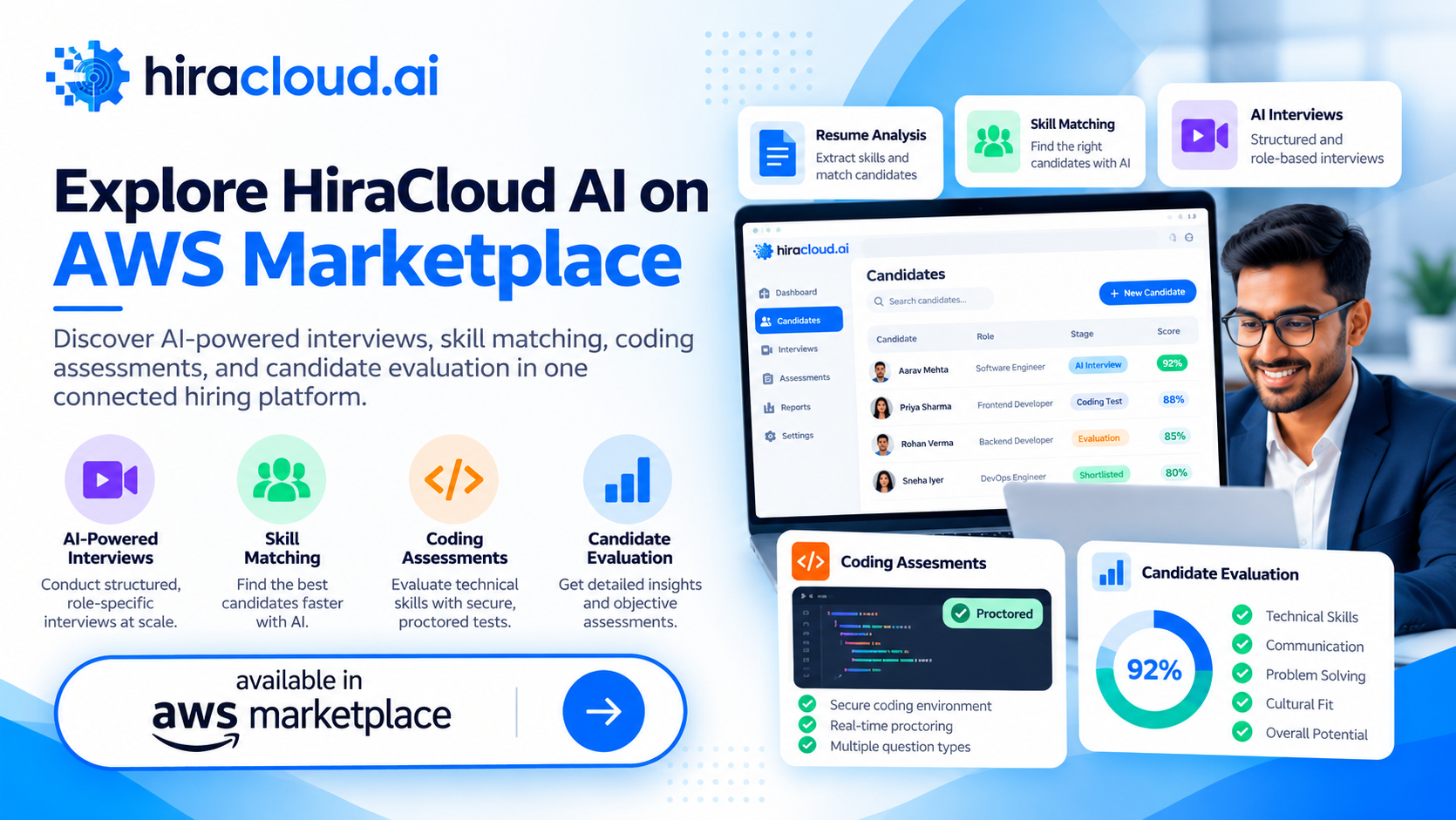
Discover AI-powered interviews, skill matching, coding assessments, and candidate evaluation in one connected hiring platform.