Hiring teams are under increasing pressure to screen and evaluate candidates quickly while maintaining hiring quality and a positive candidate experience. As organizations scale technical and enterprise hiring, traditional interview processes can become difficult to manage across large candidate volumes.
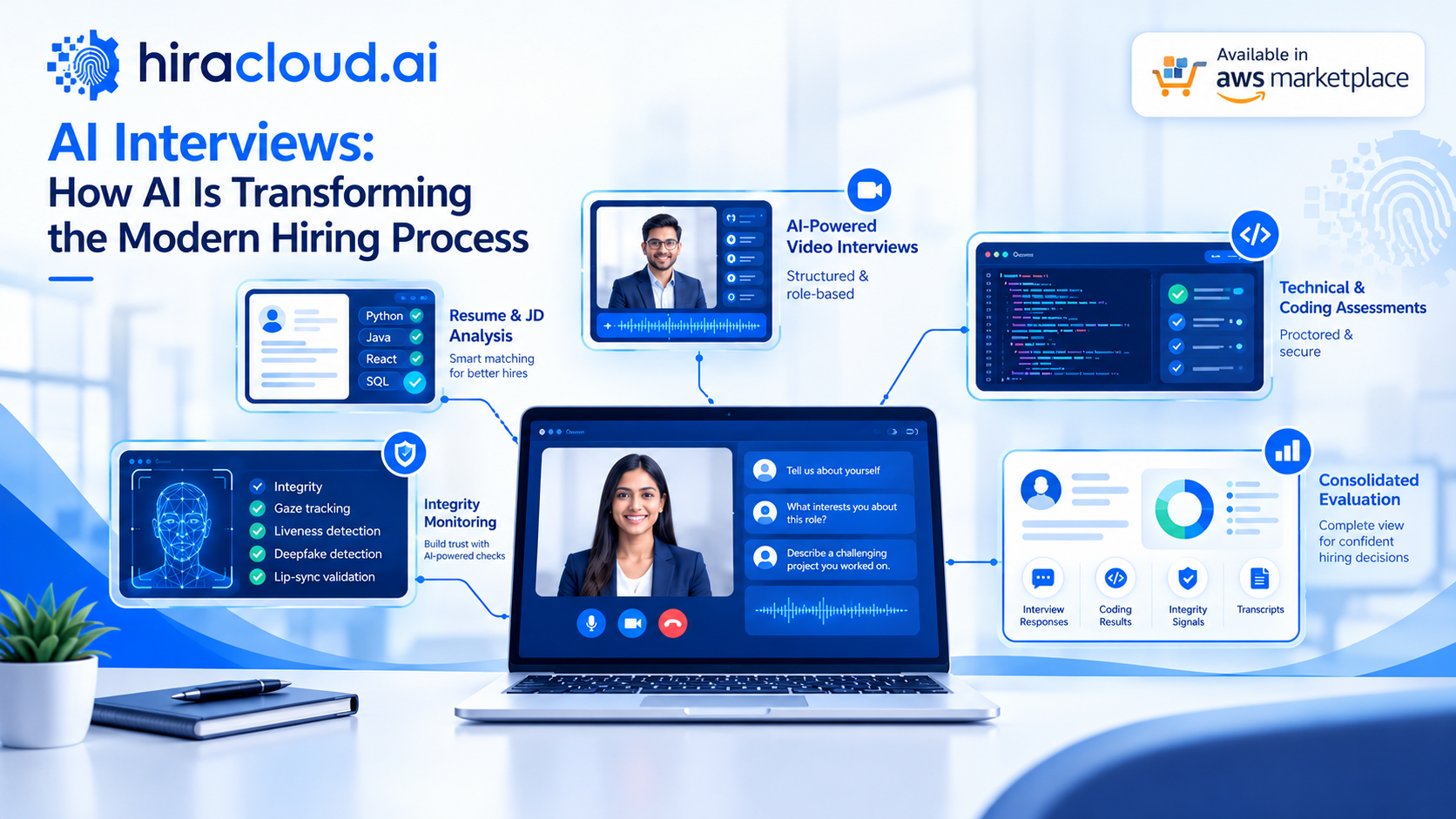
Separate tools for resume screening, video interviews, coding assessments, integrity checks, and candidate evaluation can create multiple logins, disconnected data, and manual handoffs.
AI interviews are changing how organizations approach candidate screening and evaluation. Modern AI interview technology can support structured video interviews, role-specific questioning, technical assessments, integrity monitoring, and consolidated candidate evaluation.
For enterprise organizations, technology companies, Global Capability Centers (GCCs), Offshore Delivery Centers (ODCs), and IT services organizations, AI interviews can become part of a scalable AI hiring process. Explore the HiraCloud AI hiring platform.
What Are AI Interviews?
An AI interview uses artificial intelligence to guide parts of the candidate assessment, from asking configured questions and capturing responses to organizing information for recruiter review.
Depending on the platform, an AI-powered interview can include:
- Conversational AI video interviews
- Role-specific questions
- Candidate screening
- Resume and job-description analysis
- Technical and coding assessments
- Interview transcripts
- Integrity monitoring
- Consolidated evaluation reports
The goal is not necessarily to replace human interviewers. Instead, technology can take care of parts of the early assessment workflow, while recruiters and hiring managers continue to review candidates and make the final decisions.
How Does the AI Interview Process Work?
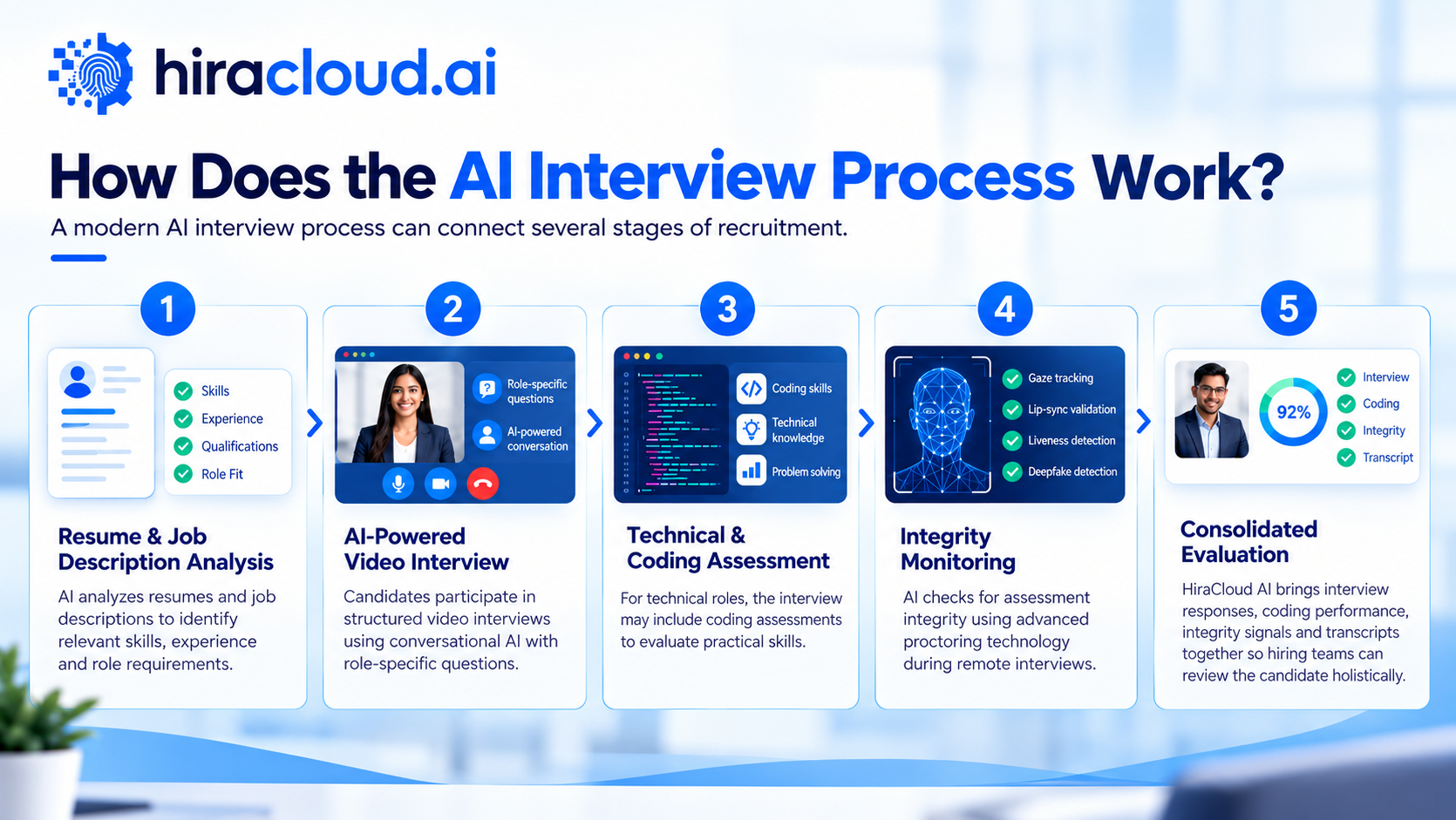
A modern AI interview process can connect several stages of recruitment.
Resume and Job Description Analysis
AI can analyze resumes and job descriptions to identify relevant skills, experience, qualifications, and role requirements. HiraCloud AI supports resume and JD intake with bidirectional skill matching, connecting candidate capabilities with job requirements before the interview stage.
AI-Powered Video Interview
Candidates can participate in structured video interviews using conversational AI. The interview can ask role-specific questions and collect responses related to technical knowledge, experience, communication, and other configured criteria. HiraCloud AI supports L1 and L2 AI-powered video interviews as part of its hiring workflow.
Technical and Coding Assessment
For technical roles, an interview may need to be combined with a practical assessment. HiraCloud AI integrates proctored coding assessments into the hiring workflow, including the ability to conduct coding assessments within the same session as an AI video interview.
Integrity Monitoring
Remote hiring creates additional assessment-integrity considerations. HiraCloud AI’s Sentinel integrity layer includes:
- Gaze tracking
- Lip-sync validation
- Liveness detection
- Deepfake detection
These signals provide additional information for recruiters and evaluators during remote interviews and assessments.
Consolidated Evaluation
HiraCloud AI brings interview responses, coding performance, integrity signals, transcripts, and other assessment information together so hiring teams can review the candidate from a broader perspective. This reduces the need for hiring teams to manually combine information from multiple systems.
Why Are Companies Adopting AI Interview Technology?
Organizations are adopting AI interview technology for several practical reasons:
- Scalable screening: AI-assisted interviews give recruiting teams a way to handle more first-stage conversations without scheduling every screening call manually.
- Consistent processes: Predefined questions and evaluation criteria can create greater consistency across candidate interviews.
- Reduced repetitive work: Recruiters can spend less time conducting repetitive first-stage screening and more time reviewing qualified candidates.
- Structured candidate information: Transcripts, responses, assessment results, and other signals can be organized for easier review.
- Technical hiring support: AI interviews can be connected with coding and technical assessments for engineering and technology roles.
These benefits can be particularly relevant when organizations need to process large numbers of candidates across multiple roles or locations.
AI Interviews vs. Traditional Interviews
| Traditional Interviews | AI-Assisted Interviews |
|---|---|
| Recruiter conducts every initial interview | AI can conduct structured initial interviews |
| Manual scheduling and coordination | Automated workflow support |
| Manual notes | Transcripts and structured information |
| Separate assessment tools | Interview and assessment can be connected |
| Manual integrity checks | Integrated integrity monitoring |
| Limited screening capacity | Greater candidate screening capacity |
AI interviews are therefore best viewed as an additional capability within the hiring process rather than simply a replacement for human interviewing.
Why Does the Single-Platform Model Matter?
Many organizations use different platforms for resume screening, video interviews, coding assessments, proctoring, and evaluation.
A fragmented workflow may look like:
This can result in multiple logins, disconnected data, manual handoffs, and additional administrative work.
A single-platform approach connects these stages:
HiraCloud AI follows this model by bringing resume and JD intake, bidirectional skill matching, conversational AI interviews, proctored coding assessments, Sentinel integrity checks, and consolidated evaluation into one hiring environment. Explore the Hiring Workflow.
AI Interviews for High-Volume Hiring
High-volume hiring can place significant operational pressure on recruiting teams. This is especially relevant for:
- Enterprise organizations
- Technology companies
- GCCs
- ODCs
- IT services organizations
- Engineering recruitment teams
- Distributed and remote hiring teams
A connected AI hiring process can help organizations manage candidate screening through a structured workflow:
For GCC and ODC recruitment, this can be particularly useful when organizations need to evaluate large numbers of technical candidates while coordinating recruiters, hiring managers, and subject matter experts.
HiraCloud AI is designed specifically around this type of connected hiring workflow for GCCs, ODCs, and IT services organizations.
AI Interviews and Agentic Hiring
AI recruitment is moving beyond individual automated tasks toward more connected and coordinated workflows. An individual AI interview tool may automate an interview. An agentic hiring platform can coordinate multiple stages of the recruitment process.
For example:
The value comes from connecting these stages rather than operating each one as a separate tool. HiraCloud AI combines candidate intake, skill matching, AI interviews, coding assessments, integrity monitoring, and evaluation within one workflow.
How to Evaluate an AI Interview Platform
Organizations evaluating an AI interview platform should consider more than whether it can conduct a video interview. Key considerations include:
Interview capabilities: Can it conduct structured, role-specific interviews?
Technical assessment: Can coding or technical assessments be integrated?
Integrity controls: Does it provide appropriate remote assessment monitoring?
Workflow integration: Can multiple hiring stages work within one platform?
Scalability: Can it support increasing candidate volumes?
Human oversight: Can recruiters and hiring managers review and interpret results?
Candidate experience: Is the interview process clear and accessible?
Data privacy and security: How are candidate recordings, transcripts, and assessment data handled?
Frequently Asked Questions
What is an AI interview?
An AI interview uses AI technology to conduct or assist with parts of a candidate interview, such as asking questions, capturing responses, generating transcripts, and organizing assessment information for review.
How does an AI interview work?
An AI interview can use job and candidate information to guide the interview, ask configured questions, capture responses, and organize assessment information for review. Depending on the platform, it may also include coding assessments and integrity monitoring.
Are AI interviews replacing human interviewers?
AI interviews can automate parts of candidate screening, but human recruiters and hiring managers can remain responsible for reviewing candidates and making hiring decisions.
Are AI interviews suitable for high-volume hiring?
AI interviews can support high-volume hiring by allowing organizations to conduct structured candidate screening at scale. Suitability depends on the organization’s roles, workflow, implementation, and human review process.
Can an AI interview include a coding test?
Yes. Some AI interview platforms integrate coding assessments with video interviews. HiraCloud AI supports proctored coding assessments within its connected hiring workflow.
What is HiraCloud AI?
HiraCloud AI is an agentic hiring cloud for GCCs and ODCs that connects resume and JD intake, bidirectional skill matching, conversational AI interviews, proctored coding assessments, integrity monitoring, and consolidated evaluation.
Conclusion
AI interviews are becoming an important part of modern recruitment as organizations look for scalable ways to screen and evaluate candidates. The technology is evolving from standalone automated interviews toward connected hiring workflows that bring together candidate screening, AI interviews, technical assessments, integrity checks, evaluation, and human decision-making.
For enterprises, technology companies, GCCs, ODCs, and IT services organizations, this connected approach can help simplify complex, high-volume hiring workflows. HiraCloud AI brings these capabilities together through one hiring environment, helping organizations connect the journey from resume and JD intake to AI interview, technical assessment, integrity checks, and candidate evaluation.
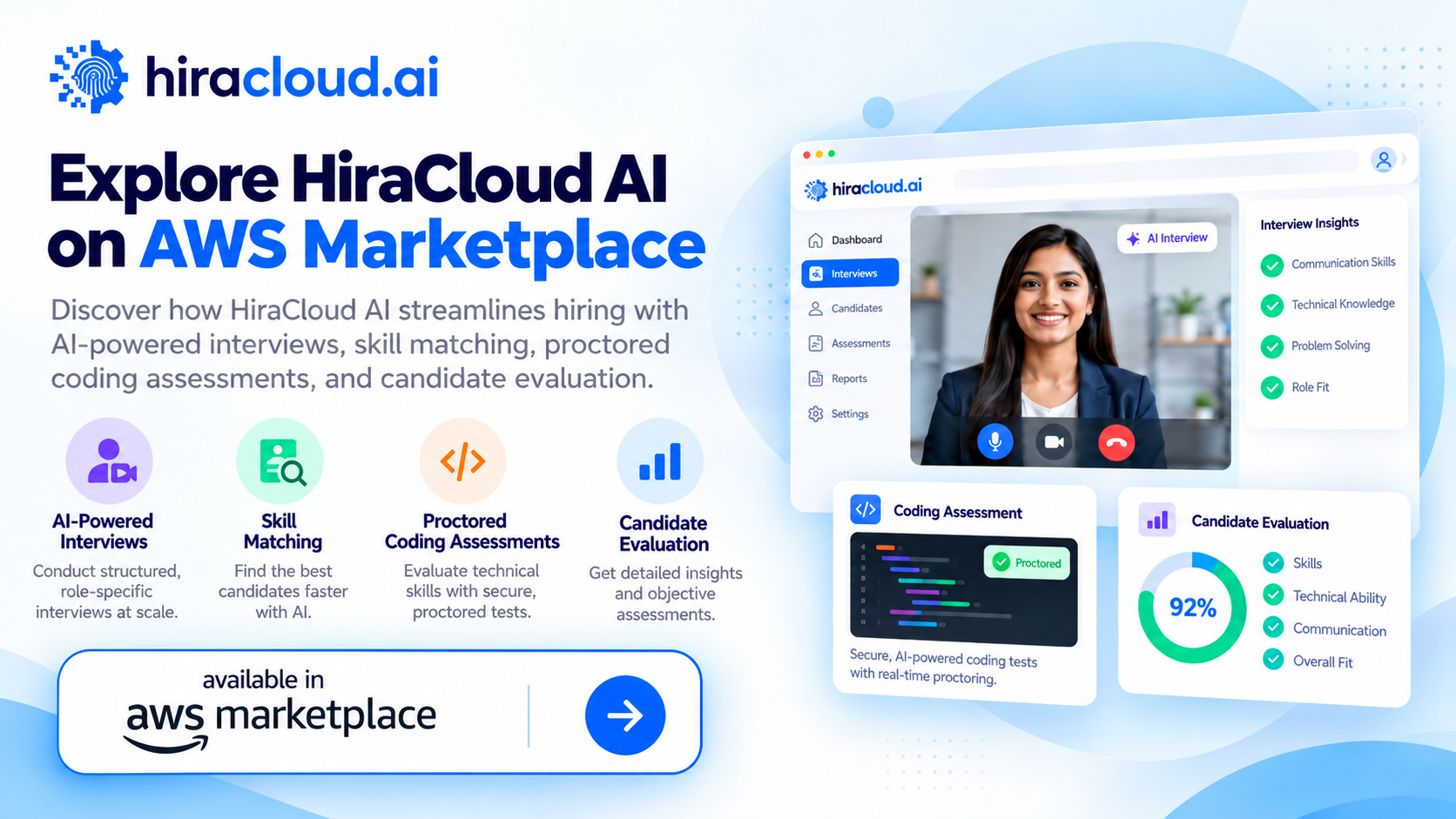
Explore HiraCloud AI on AWS Marketplace
Discover how HiraCloud AI streamlines hiring with AI-powered interviews, skill matching, proctored coding assessments, and candidate evaluation.