HiraCloud.Ai Product Overview:
One Workflow
Seven integrated stages from candidate intake to final evaluation — all in one platform, one login, zero integration tax. Watch each stage in action.
Extract and structure resume & job description data
Intelligent parsing of CVs and job descriptions. Our AI extracts key information including skills, experience, qualifications, and requirements, normalizing data for accurate matching.
Key Features
- Automated data extraction
- Format-agnostic processing
- Skill normalization
- Role requirement mapping
What Happens Here
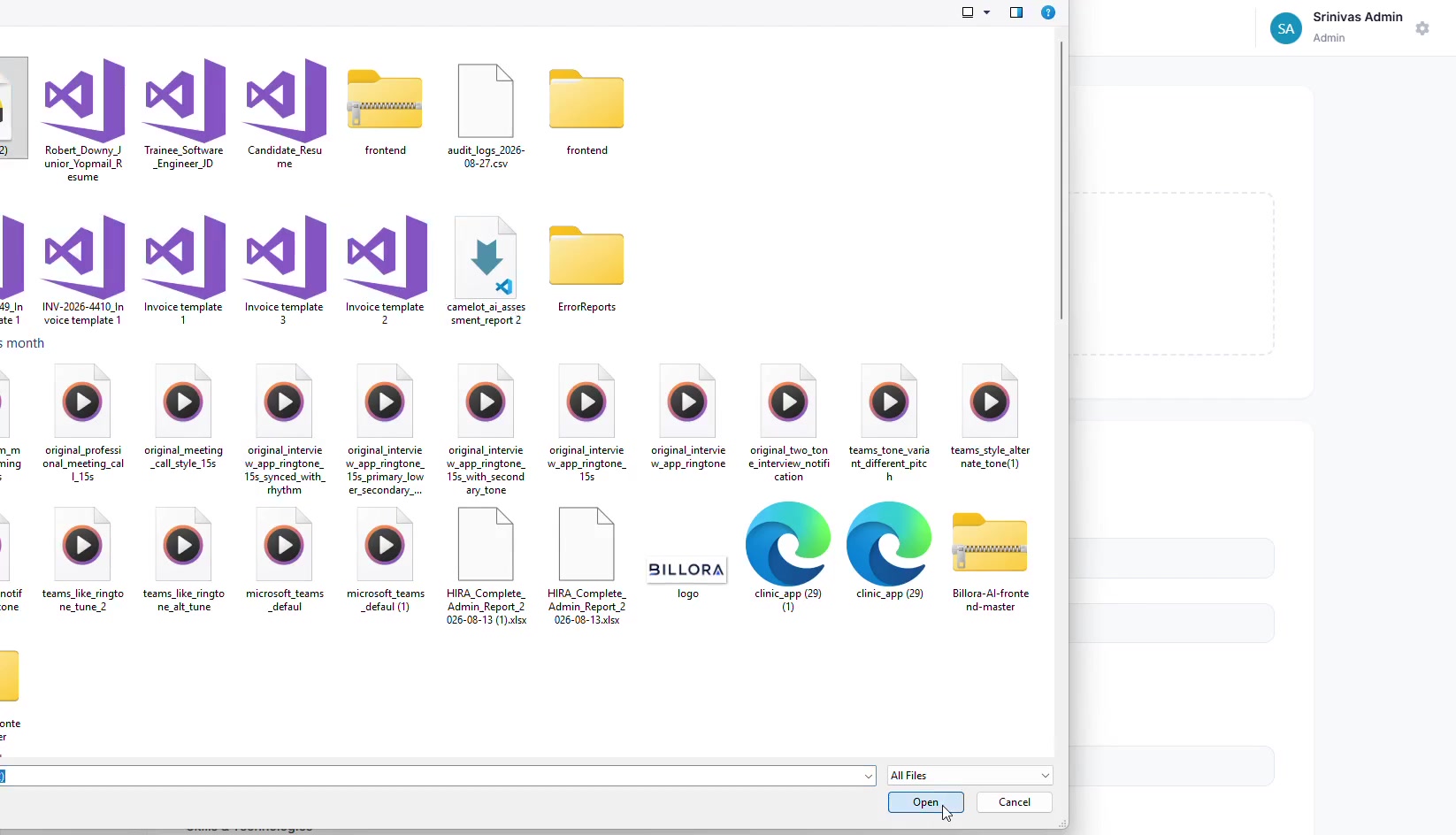
When a recruiter uploads a candidate's CV and a job description, HIRA immediately extracts structured data. Our AI reads through various CV formats (PDF, DOCX, images) and standardizes the information into a unified schema. The job description is similarly parsed to extract role requirements, must-have and nice-to-have skills, experience levels, and compensation bands.
Recruiters upload a candidate's CV, HIRA instantly maps must-have vs. nice-to-have skills, experience bands, and compensation thresholds, standardizing them into a single structured schema.
Bidirectional skill matching & candidate ranking
Intelligent parsing of CVs and job descriptions. Our AI extracts key information including skills, experience, qualifications, and requirements, normalizing data for accurate matching.
Key Features
- Semantic skill matching
- Experience relevance scoring
- Compatibility analysis
- Adjacent skill identification
What Happens Here
With CV and JD data extracted, HIRA's matching engine runs semantic analysis. It doesn't just look for keyword matches—it understands that a "Software Architect" has transferable skills for a "Technical Lead" role. The engine produces compatibility scores and surfaces not just exact matches but candidates who could grow into the role. Adjacent skill identification helps recruiters see candidates qualified for related roles.
HIRA's matching engine identifies candidate growth potential. A 'Software Architect' is mapped logically for 'Technical Lead' openings, helping match adjacent skill opportunities.
Automated coordination with candidates
Autonomous scheduling agents handle all coordination. No back-and-forth emails. Candidates receive invites with available time slots, confirmations are logged, and reminders are sent automatically.
Key Features
- Autonomous scheduling agent
- Multi-timezone support
- Calendar integration
- Automated reminders
What Happens Here
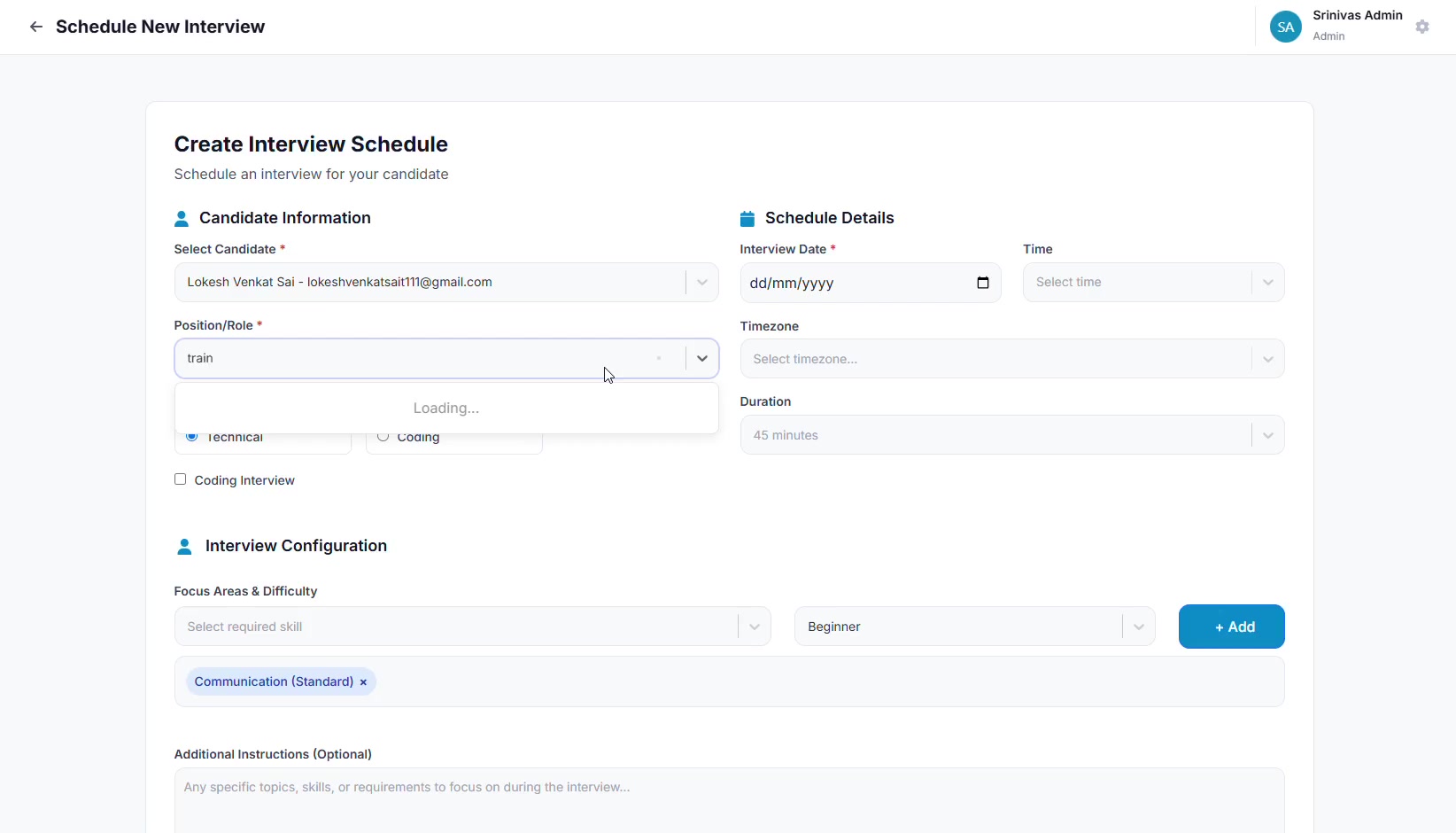
Once candidates are shortlisted, HIRA's autonomous agent takes over scheduling. It pulls available time slots from the interviewer's calendar, accounts for timezones, and sends candidates a single invitation with clickable time slots. No email chains. When a candidate accepts, the interviewer's calendar updates automatically, and both parties receive reminders 24 hours and 1 hour before the scheduled interview.
Once candidate shortlists are confirmed, HIRA schedules everything. Clickable timing templates align securely to the interviewer's availability and update directly.
Conversational AI-powered video interviews
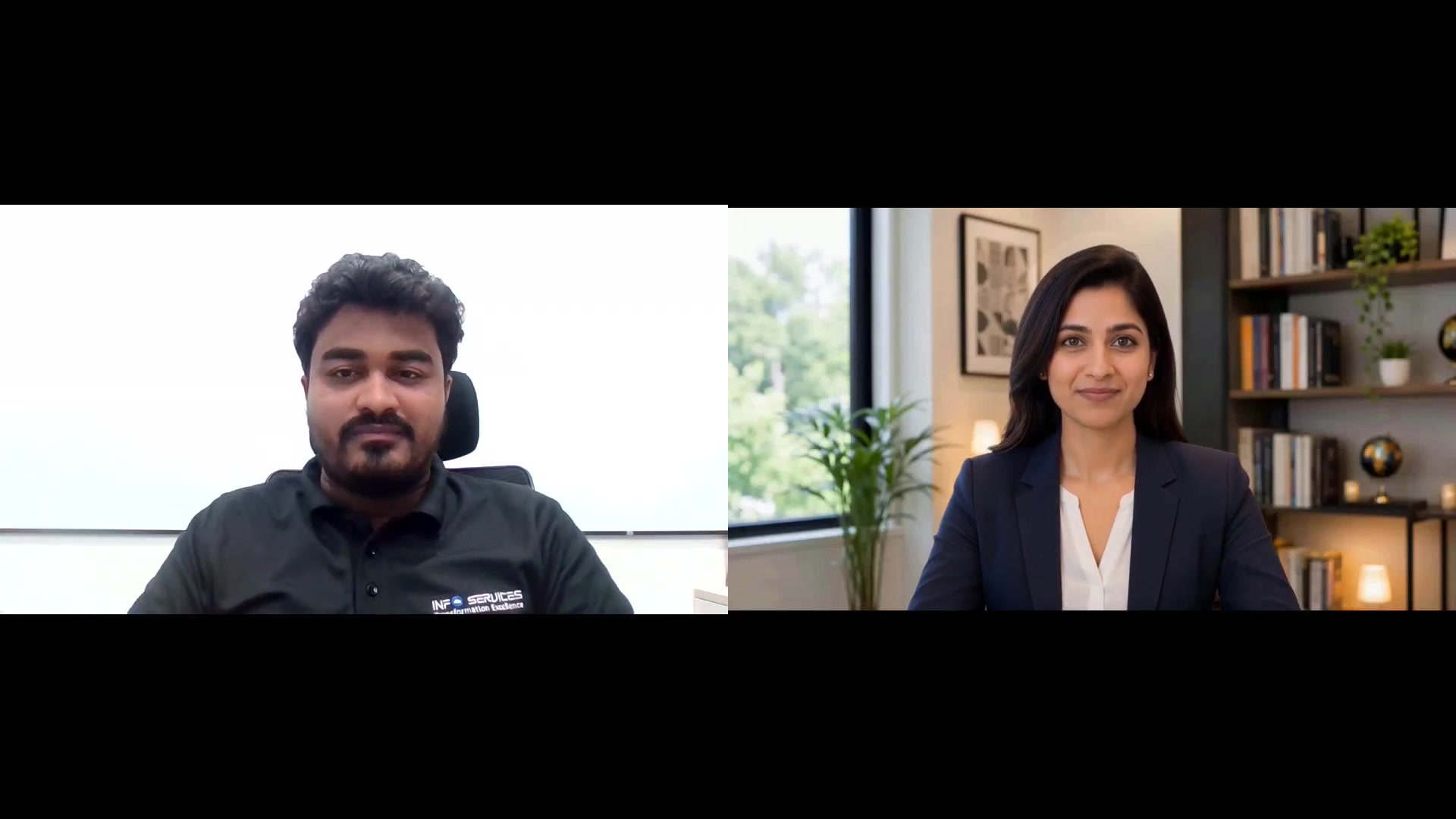
Candidates participate in live L1/L2 video interviews powered by conversational AI. The platform asks behavioral and technical questions, adapts to responses, and runs Sentinel integrity checks inline — gaze tracking, liveness detection, lip-sync validation.
Key Features
- Conversational AI interviewer
- Real-time gaze tracking
- Liveness detection
- Lip-sync validation
- In-line Sentinel checks
All data is captured:
video, audio transcripts, integrity events, and question-answer pairs.
What Happens Here
At the scheduled time, the candidate joins a video interview session. HIRA's conversational AI conducts the interview, asking tailored questions based on the role and the candidate's background. The Sentinel Layer runs simultaneously:
HIRA's conversational AI evaluates behavioral and technical skills. Simultaneously, the Sentinel Layer detects proxy voice-overs, liveness signals, and looking-away cues.
Integrated technical assessment during session
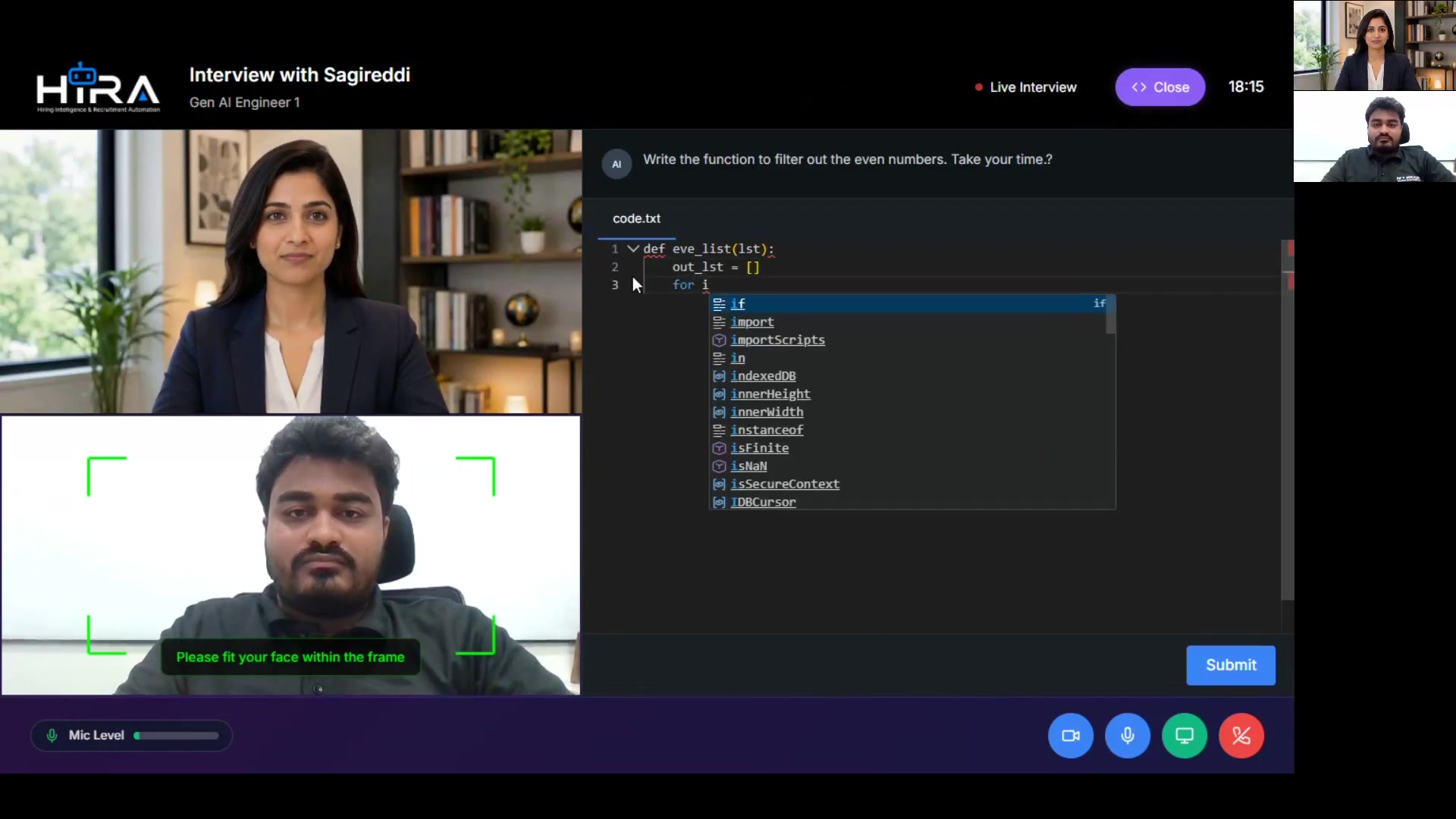
Technical coding assessments run in the same session as the video interview. Candidates solve coding problems in a proctored environment under the same Sentinel integrity layer. All under unified proctoring.
Key Features
- In-session coding problems
- Multi-language support
- Live code compilation
- Unified proctoring layer
- Automated grading
What Happens Here
During the same video session, candidates transition to the coding test environment. They can choose from supported languages (Python, JavaScript, Java, C++, etc.) and solve 1–3 problems tailored to the role's difficulty level. Their code is compiled and tested in real-time. The Sentinel Layer continues to run, ensuring interview integrity through the coding segment. No context-switching between platforms, no second login.
During the interview, candidates transition smoothly into technical playgrounds. They compile solutions in real-time under a unified proctoring footprint without switching tools.
Automated technical assessment scoring
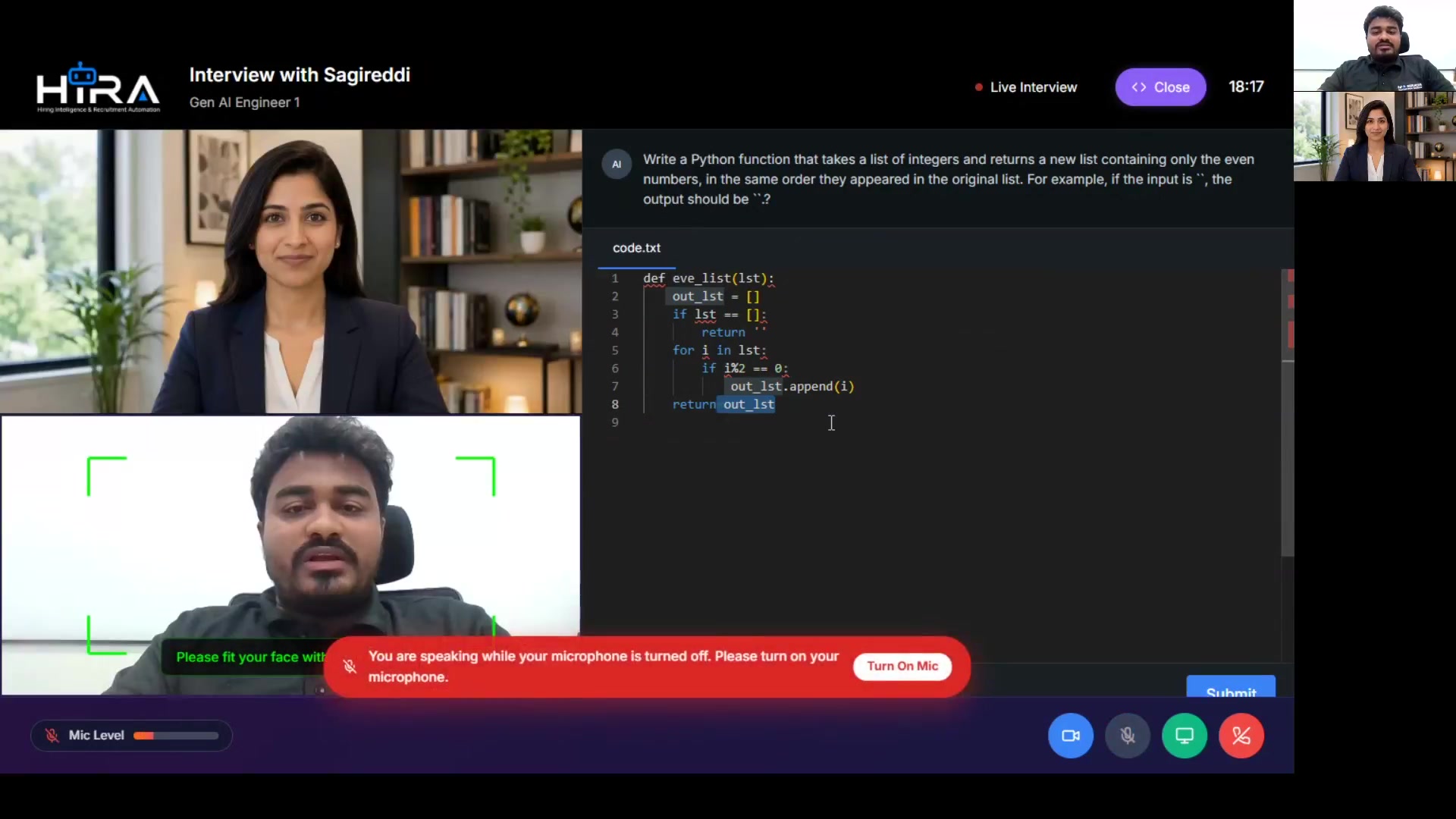
Automated evaluation of coding solutions. The platform scores code quality, correctness, efficiency, and style against predefined rubrics. Results are immediately available.
Key Features
- Automated code analysis
- Quality scoring
- Efficiency metrics
- Style evaluation
- Immediate results
What Happens Here
After the candidate submits their code, HIRA evaluates it across multiple dimensions:
After candidate submissions, HIRA evaluates correctness, space-time complexity optimization, and adherence to language-specific best practices immediately.
- Correctness: Does the code solve the problem?
- Efficiency: Is the solution optimized for time and space?
- Code Quality: Is it readable and maintainable?
- Best Practices: Does it follow language conventions?
Scores are available immediately, so the candidate and interviewer can discuss results within the session if needed.
Consolidated scoring, insights & integrity findings
One unified evaluation report consolidates: interview transcripts, behavioral & technical scores, coding results, integrity findings (gaze tracking, liveness), soft-skills assessment, and competency mapping. Exportable and actionable.
Key Features
- Consolidated scoring
- Interview transcripts
- Competency mapping
- Integrity findings
- Export & sharing
- Talent analytics
What Happens Here
Within minutes of the interview ending, HIRA generates a comprehensive evaluation report:
HIRA generates a comprehensive report summarizing communication, technical correctness, liveness parameters, and final recommendations.
Why HIRA Differs
One Coordinated Platform
No stitching together 4 vendors. One login, one UI, one workflow.
One Unified Report
Everything—interview, coding, integrity, soft skills—converges into one actionable report for hiring teams.
Zero Integration Tax
Deploy on day one. No custom middleware, no data synchronization headaches, no vendor management overhead.
Integrity Built In
Sentinel checks run inline across interview and coding—the same integrity layer covers the entire session.
Integrated Coding Test
Coding happens in the same session as the interview, under the same proctoring. Candidates don't context-switch between tools.
The Impact
Traditional Hiring Cycle: 6–8 weeks
- Resume screening: Wk 1–2
- HR screening & scheduling: Wk 2–3
- Technical + coding tests: Wk 3–5
- Final interviews: Wk 5–6
- Offer & negotiation: Wk 6–8
HIRA-Enabled Hiring Cycle: 3–4.5 weeks
- AI match & shortlist: Wk 1
- AI screening & scheduling: Wk 2
- AI technical interview + coding: Wk 2–3
- Final interview: Wk 3
- Offer & close: Wk 3–4
Ready to See
HIRA in Action?
Book a personalized demo to see how HIRA transforms hiring for GCCs and ODCs.