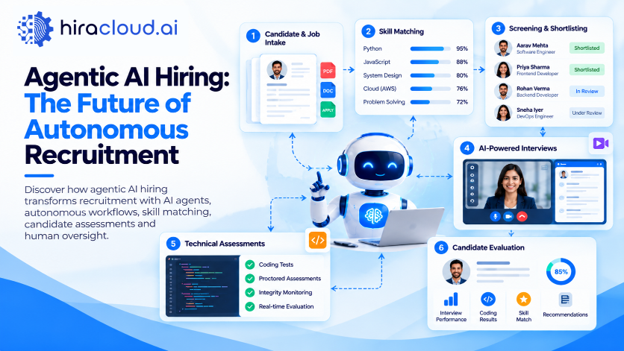
Recruitment is evolving beyond traditional automation. While conventional recruitment software helps organizations manage applications and automate individual tasks, agentic AI introduces a more coordinated approach in which AI agents can work toward defined objectives, execute supported actions and coordinate multiple stages of a workflow.
For organizations managing complex recruitment operations, this shift creates opportunities to connect candidate sourcing, resume analysis, skill matching, interviews, technical assessments and candidate evaluation within a more integrated hiring process.
Agentic AI hiring refers to the use of AI agents to coordinate and perform selected recruitment activities with a degree of autonomy, according to defined objectives, permissions and workflow rules. Instead of treating every recruitment task as a separate operation, agentic AI recruitment can connect multiple activities while keeping recruiters involved in important decisions.
This approach is particularly relevant for enterprises, technology companies, Global Capability Centers (GCCs), Offshore Delivery Centers (ODCs) and IT services organizations that need to evaluate technical talent across multiple roles and locations.
HiraCloud AI is an agentic hiring cloud designed for GCCs, ODCs and enterprise technical hiring teams. It connects resume and job description intake, bidirectional skill matching, conversational AI interviews, proctored coding assessments, integrity monitoring and consolidated candidate evaluation within one hiring environment. Explore the HiraCloud AI Platform.
What Is Agentic AI Hiring?
Agentic AI hiring is an approach to recruitment in which AI agents can coordinate multiple hiring activities, use available information to determine appropriate next steps and perform permitted actions within a defined workflow.
Unlike systems that automate only one task, agentic AI recruitment focuses on connecting activities toward a broader recruitment objective.
For example, a recruitment workflow may involve receiving candidate information, analyzing a resume, matching skills against job requirements, initiating an assessment and preparing candidate information for recruiter review. An agentic system may coordinate supported steps according to configured rules, system capabilities and approval requirements.
Common capabilities associated with agentic AI hiring include:
- Candidate information intake and processing
- Resume and job description analysis
- Candidate-to-job skill matching
- Coordination of screening activities
- AI-powered interview workflows
- Technical and coding assessment coordination
- Candidate information consolidation
- Workflow status updates and task routing
- Recruiter review and decision support
The capabilities of agentic recruitment systems vary by provider. Some systems primarily coordinate predefined workflows, while others can use AI agents to plan and execute a broader set of permitted actions.
Agentic AI should not be assumed to operate without supervision. Recruitment decisions can significantly affect candidates, so appropriate permissions, transparency, monitoring and human oversight remain essential.
How Does Agentic AI Recruitment Work?
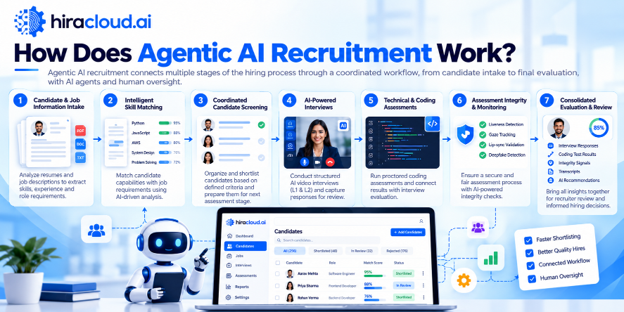
Agentic AI recruitment can connect multiple stages of the hiring process through a coordinated workflow. The exact implementation depends on the platform, available integrations, configured rules and the level of autonomy permitted.
Candidate and Job Information Intake
The process begins with candidate information and job requirements. An AI-enabled recruitment system can analyze resumes, interpret job descriptions and organize relevant information, including skills, experience, qualifications and role-specific competencies. This information provides the foundation for subsequent recruitment activities. HiraCloud AI supports resume and job description intake as part of its connected hiring workflow.
Intelligent Candidate Skill Matching
After processing candidate and job information, the system can help identify potential matches between candidate capabilities and role requirements. Skill matching can consider technical competencies, relevant experience and configured evaluation criteria. This can help recruitment teams identify profiles for further assessment. HiraCloud AI supports bidirectional skill matching, connecting candidate capabilities with job requirements before interviews and technical assessments.
Coordinated Candidate Screening
Agentic AI recruitment can connect candidate screening with subsequent hiring activities rather than treating screening as an isolated task. Depending on the system's capabilities, this may involve organizing candidate profiles, identifying missing information, routing applications for review or preparing candidates for the next assessment stage. Automated actions should follow clearly defined criteria. Recruiters should be able to review screening outcomes, address exceptions and ensure that relevant candidates are not excluded solely because of automated assessments.
AI-Powered Interviews
Interviews are an important stage in evaluating candidate experience, technical knowledge and role-specific capabilities. AI-powered interview systems can conduct structured interviews, ask configured questions, capture responses and organize interview information for review. Within an agentic recruitment workflow, interview activities can be connected to candidate information and subsequent assessment stages. HiraCloud AI supports L1 and L2 AI-powered video interviews within its connected hiring workflow. Explore our guide to AI interviews and how they transform modern hiring for a deeper look at interview capabilities and use cases.
Technical and Coding Assessment Coordination
Technical recruitment often requires practical evidence of a candidate's skills beyond resumes and interview responses. Agentic AI hiring workflows can coordinate technical assessments as part of a broader candidate evaluation process, subject to the platform's available capabilities. HiraCloud AI integrates proctored coding assessments into its hiring workflow, including the ability to conduct coding assessments within the same session as an AI video interview. Connecting these activities can help hiring teams review interview responses alongside technical assessment results.
Assessment Integrity and Monitoring
Remote interviews and online assessments introduce additional considerations related to candidate identity and assessment integrity. Depending on the platform, integrity controls may include liveness detection, gaze-related signals, lip-sync validation and deepfake detection. HiraCloud AI's Sentinel integrity layer includes gaze tracking, lip-sync validation, liveness detection and deepfake detection. These signals should be interpreted carefully. They can provide additional information for review, but should not automatically be treated as definitive evidence of misconduct without appropriate verification and human judgment.
Consolidated Evaluation and Recruiter Review
The final stage brings together the available candidate information for review. A connected hiring platform can organize skill-matching information, interview responses, transcripts, coding assessment results and relevant integrity signals within a unified evaluation process. HiraCloud AI brings these capabilities together in one hiring environment to support recruiter review and informed hiring decisions. Human recruiters and hiring managers remain responsible for evaluating context, investigating discrepancies and making final hiring decisions.
Explore the HiraCloud AI Product Workflow to see how candidate intake, skill matching, AI interviews, technical assessments and candidate evaluation connect within one hiring process.
Agentic AI Hiring vs. Traditional Recruitment Automation
Traditional recruitment automation and agentic AI hiring can both support hiring operations, but they differ in how tasks are executed and coordinated.
Traditional automation typically executes predefined rules or triggers, such as sending a confirmation email after an application is submitted or moving a candidate to the next stage when a test score is recorded. In contrast, agentic AI recruitment can connect multiple activities toward an objective, using available context to coordinate actions across different stages.
Agentic AI does not automatically make a recruitment process more effective. Its value depends on workflow design, data quality, integration with existing systems and appropriate human oversight.
Organizations should evaluate what a platform actually does rather than assuming that the term agentic automatically indicates superior performance.
Agentic AI Hiring vs. AI Recruitment Agents
The terms agentic AI hiring and AI recruitment agents are closely related, but they describe different aspects of recruitment technology.
Agentic AI hiring describes the overall recruitment approach in which AI agents coordinate and perform activities across a hiring workflow.
AI recruitment agents are the software agents that perform or support specific tasks within that workflow.
Depending on their design and permissions, AI recruitment agents may assist with:
- Analyzing candidate and job information
- Identifying potential skill matches
- Organizing candidate records
- Coordinating assessment steps
- Preparing information for recruiter review
- Routing tasks according to configured rules
An individual agent may handle a specific activity, while multiple agents can work together within an agentic hiring workflow. However, not every AI-powered recruitment feature is an autonomous agent. Evaluators should check which tasks are automated and how actions are controlled.
What Are the Benefits of Agentic AI Recruitment?
Agentic AI recruitment can offer operational advantages when implemented appropriately and aligned with an organization's recruitment requirements.
Reduced Recruitment Coordination
Recruitment teams often spend time coordinating activities between different tools and stakeholders. Connected workflows can reduce some manual handoffs by making candidate information and assessment status available within one environment. The actual benefit depends on the recruitment process and the systems being connected.
Support for High-Volume Hiring
Organizations handling large numbers of applicants may struggle to review resumes, schedule interviews and coordinate assessments manually. Agentic workflows can help organize recruitment stages and support consistent process execution. Human review capacity, assessment quality and platform performance remain important factors.
More Connected Candidate Evaluation
Candidate information can become fragmented when resumes, interview feedback, coding results and proctoring data exist in separate systems. A connected workflow can help recruiters review information from multiple stages within a unified evaluation record.
Less Repetitive Administrative Work
Recruiters may spend significant time moving information between systems, updating status records and managing routine communications. Automation can reduce selected repetitive tasks, allowing recruiters to focus on candidate engagement and hiring decisions.
Support for Technical Recruitment
Technical hiring often requires multiple forms of assessment, including resume screening, structured interviews and practical coding evaluations. Agentic AI recruitment can coordinate these activities within a single workflow, making it easier to evaluate candidates consistently.
More Consistent Workflow Execution
Configured workflows can help recruitment teams apply the same assessment stages and criteria across candidates applying for similar roles. Consistency does not automatically guarantee fair or accurate evaluation, so organizations should monitor outcomes regularly.
Better Recruitment Process Visibility
When recruitment activities and assessment results are connected, hiring teams can track candidate progress through different stages of evaluation. This can help recruiters coordinate work, identify outstanding actions and review candidate history more easily.
Use Cases for Autonomous Recruitment
Autonomous recruitment can be useful for selected recruitment scenarios, particularly where candidate volume, assessment complexity or coordination overhead create challenges for hiring teams.
Enterprise Recruitment
Large organizations often manage multiple hiring teams, departments and recruitment requirements. Connected agentic workflows can help coordinate screening, interviews and evaluations across different business units.
GCC and ODC Hiring
Global Capability Centers and Offshore Delivery Centers frequently hire technical talent at scale across distributed locations. Agentic AI hiring can help connect screening, interviews, technical assessments and evaluation across time zones.
Software Engineering Recruitment
Engineering recruitment may involve resume analysis, technical interviews, coding assessments and candidate evaluation. A connected workflow can help hiring teams organize these stages within a unified environment.
High-Volume Candidate Screening
Organizations receiving large numbers of applications may use AI-assisted screening and workflow automation to organize candidate information and prioritize further review. Screening criteria should remain job-related, transparent and subject to human oversight.
Distributed Recruitment Teams
When recruiters and hiring managers work across different locations, connected workflows can help make candidate information accessible to authorized stakeholders and coordinate assessment stages.
What Should Organizations Consider Before Adopting Agentic AI Hiring?
Adopting agentic AI recruitment requires more than selecting an AI-enabled platform. Organizations should evaluate its operational capabilities, limitations and governance requirements.
Define the Level of Autonomy
Determine which activities the system can perform independently, which require approval and which must remain under human control. For example, organizing candidate records may be suitable for automation, while rejecting a candidate or making a final hiring decision requires careful consideration and appropriate oversight.
Evaluate Workflow Integration
Confirm whether the platform connects the recruitment stages your organization actually uses, including candidate intake, skill matching, interviews, coding assessments and evaluation. Check which integrations are available and whether manual data transfers are still required.
Review Data Privacy and Security
Candidate resumes, interview recordings, transcripts and assessment records may contain sensitive personal information. Understand how the system processes, stores, accesses and retains candidate data. Review applicable privacy obligations, access controls and security requirements before implementation.
Monitor Fairness and Assessment Quality
AI systems can reproduce or amplify problems in their training data, configuration or evaluation criteria. Use job-related screening standards, review potential bias, monitor outcomes and provide appropriate mechanisms for human review.
Establish Human Oversight
Define who reviews candidate assessments, handles exceptions, investigates questionable results and makes final hiring decisions. AI-generated recommendations should not be treated as unquestionable evidence of a candidate’s suitability.
Measure Operational Outcomes
Establish baseline metrics before deployment. Useful measures include time spent on initial screening, assessment coordination duration, recruiter administrative workload, candidate completion rates, assessment consistency, and candidate experience.
How HiraCloud AI Supports Connected Hiring Workflows
HiraCloud AI is positioned as an agentic hiring cloud for GCCs, ODCs and enterprise technical hiring teams. Its connected hiring capabilities include:
- Resume and job description intake
- Bidirectional skill matching
- L1 and L2 AI-powered video interviews
- Proctored coding assessments
- Sentinel integrity monitoring
- Consolidated candidate evaluation
These capabilities help connect candidate intake, assessment and evaluation within one hiring environment. For organizations evaluating agentic AI hiring, the important consideration is how individual capabilities work together to support the recruitment process, while preserving appropriate recruiter oversight.
Frequently Asked Questions
What is agentic AI hiring?
Agentic AI hiring is an approach to recruitment in which AI agents can coordinate and perform permitted hiring activities toward defined objectives. Depending on the system, these activities may include candidate information processing, skill matching, assessment coordination and preparation of evaluation information for recruiters.
How does agentic AI recruitment work?
Agentic AI recruitment connects recruitment activities through configured workflows and AI agents. The system may analyze candidate information, coordinate screening, initiate supported assessment steps and organize results for review. The exact process depends on platform capabilities, permissions and human approval requirements.
What are AI recruitment agents?
AI recruitment agents are software agents designed to perform or coordinate selected recruitment activities. Depending on their capabilities, they may help analyze resumes, match skills, organize candidate information, coordinate assessments or support recruiter workflows.
What is the difference between agentic AI and recruitment automation?
Traditional recruitment automation typically executes predefined actions based on rules or triggers. Agentic AI may additionally use AI to interpret context, coordinate tasks and determine next steps within defined boundaries. The distinction depends on the actual capabilities of the system.
Can agentic AI replace recruiters?
Agentic AI can assist with selected recruitment activities, but it should not be assumed to replace recruiters. Human involvement remains important for candidate engagement, contextual judgment, fairness reviews, exception handling and final hiring decisions.
Is autonomous recruitment fully independent?
Not necessarily. Autonomy varies by platform and use case. A system may perform certain administrative actions independently while requiring approval for other steps. Organizations should establish clear permissions, monitoring and escalation procedures.
How can agentic AI support technical hiring?
Agentic AI can help coordinate resume analysis, skill matching, structured interviews, coding assessments and candidate evaluation. Connected workflows can make it easier for recruitment teams to review available evidence across different assessment stages.
What are the risks of agentic AI recruitment?
Potential risks include biased screening criteria, inaccurate assessments, insufficient transparency, inappropriate access to candidate data and excessive reliance on automated recommendations. Organizations should establish governance, security controls, human oversight and ongoing performance monitoring.
How does HiraCloud AI support agentic AI hiring?
HiraCloud AI brings resume and job description intake, bidirectional skill matching, AI-powered interviews, proctored coding assessments, Sentinel integrity monitoring and consolidated candidate evaluation together within one hiring environment.
Conclusion
Agentic AI hiring represents an evolution from automating individual recruitment tasks toward coordinating multiple activities within connected hiring workflows.
By connecting candidate intake, skill matching, screening, interviews, technical assessments and evaluation, agentic AI recruitment can help organizations organize complex hiring operations and reduce selected administrative tasks.
However, effective implementation requires clear workflow boundaries, reliable data, appropriate integrations, privacy safeguards and human oversight. The goal is not simply to automate more activities, but to build a recruitment process that supports informed and responsible hiring decisions.
For enterprises, GCCs, ODCs and technology organizations, HiraCloud AI brings candidate intake, skill matching, AI interviews, coding assessments, integrity monitoring and consolidated evaluation together within one hiring environment.
Explore HiraCloud AI on AWS Marketplace
Discover AI-powered interviews, skill matching, coding assessments and candidate evaluation in one connected hiring platform.