Interview scheduling is an important part of the recruitment process, but coordinating interviews across candidates, recruiters and hiring managers can become complicated as organizations scale their hiring operations.
Recruitment teams often manage multiple calendars, interview availability, time zones, rescheduling requests and candidate communication. These activities can create administrative work and delays, particularly for organizations recruiting across multiple roles and locations.
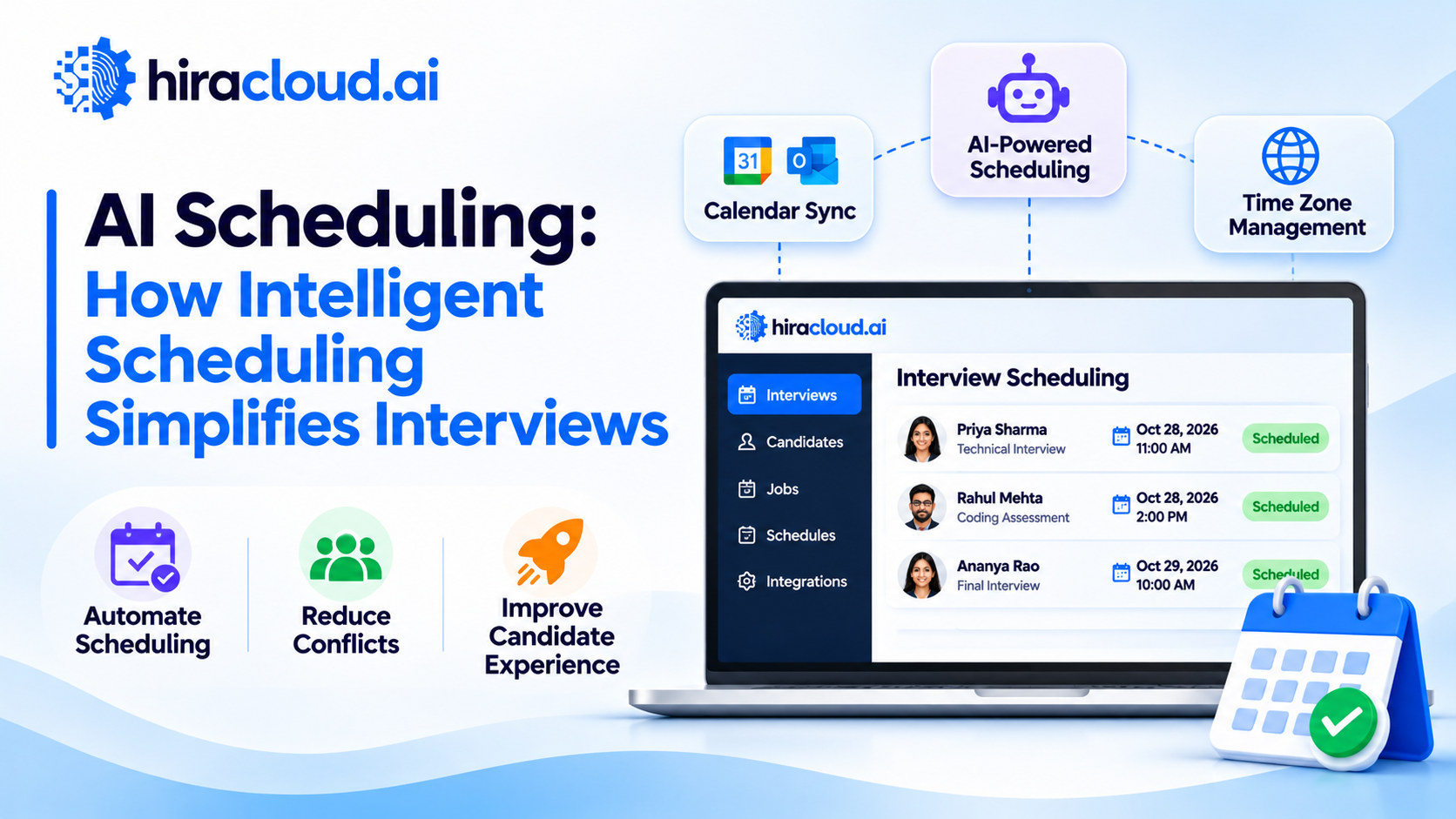
AI scheduling introduces intelligent automation into interview coordination. By helping recruitment teams organize scheduling information, manage availability and coordinate interview activities, AI-powered scheduling solutions can support a more structured hiring process.
For enterprises, Global Capability Centers (GCCs), Offshore Delivery Centers (ODCs) and technology organizations, efficient interview scheduling can help improve recruitment coordination while providing candidates with a more organized interview experience.
Explore the HiraCloud AI Platform to see how intelligent automation and connected workflows empower enterprise technical recruitment.
What Is AI Scheduling?
AI scheduling refers to the use of artificial intelligence and automation to support the planning, coordination and management of scheduled activities.
In recruitment, AI scheduling can help coordinate interviews by managing availability, identifying suitable time slots, organizing interview appointments and supporting candidate communication.
Traditional interview scheduling often involves recruiters manually checking calendars, contacting candidates and coordinating with hiring managers.
Interview scheduling software can automate some of these activities through predefined rules and calendar integrations. AI-enabled scheduling may additionally support intelligent recommendations, natural-language interactions and more flexible coordination, depending on the platform.
The actual capabilities vary by provider. Organizations should distinguish between rule-based scheduling automation and AI systems that can interpret scheduling requirements or coordinate permitted actions.
Why Is Interview Scheduling Important in Recruitment?
Interview scheduling directly affects recruitment coordination and candidate experience.
When scheduling processes are inefficient, candidates may experience delays, recruiters may spend additional time coordinating appointments, and hiring managers may struggle to maintain interview availability.
An organized interview scheduling process can help organizations:
- Reduce manual coordination between recruiters and candidates.
- Improve communication about interview dates and times.
- Minimize scheduling conflicts and unnecessary rescheduling.
- Coordinate interviews across multiple hiring stakeholders.
- Support a more consistent candidate experience.
- Improve visibility into upcoming interviews and outstanding activities.
For organizations conducting high-volume or technical recruitment, these benefits become particularly relevant as the number of interviews increases.
Common Interview Scheduling Challenges
Coordinating Multiple Calendars
Recruiters often need to identify suitable interview slots across candidates, interviewers and hiring managers. Conflicting calendar availability can make this process time-consuming.
Managing Different Time Zones
Global recruitment teams may conduct interviews across multiple countries and regions. Coordinating time zones accurately is essential to avoid confusion and missed appointments.
Handling Rescheduling Requests
Candidates and interviewers may need to change interview times because of availability issues. Rescheduling can create additional coordination work when multiple stakeholders are involved.
Maintaining Candidate Communication
Candidates need timely information about interview schedules, meeting links, preparation requirements and changes to appointments. Delayed communication can create uncertainty and negatively affect the candidate experience.
Scaling Interview Coordination
As recruitment volumes increase, managing interview appointments manually becomes more difficult. Recruiters may need to coordinate multiple interview stages for several candidates simultaneously.
These challenges highlight the importance of structured scheduling workflows and appropriate recruitment automation.
How AI Interview Scheduling Works
AI interview scheduling can support different stages of interview coordination, depending on the platform's available capabilities and integrations.
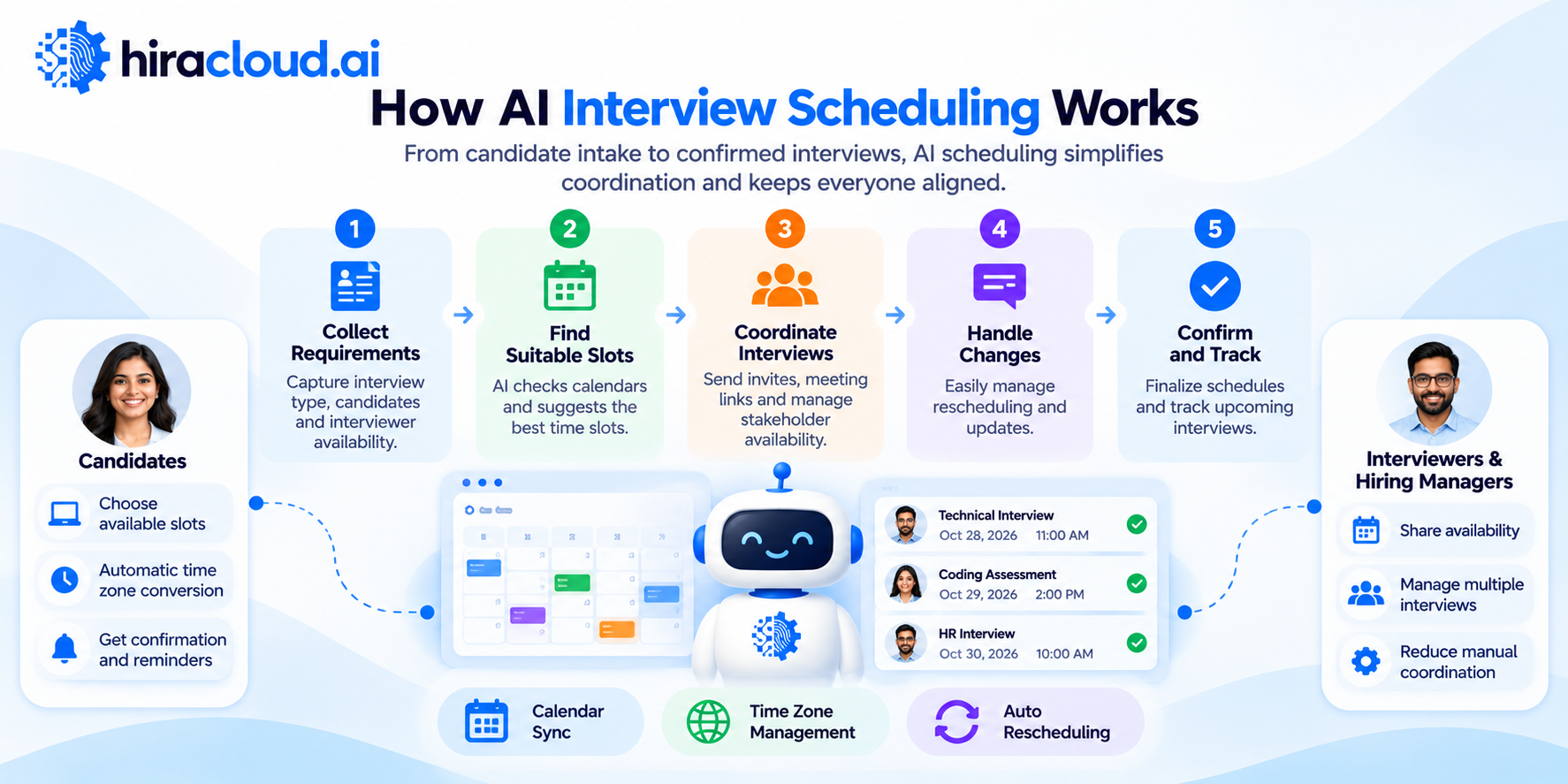
Collecting Interview Requirements
The scheduling process begins with information about the candidate, interview type, interviewer availability and required assessment stage.
A recruitment system can organize these details to establish the scheduling requirements.
Identifying Suitable Time Slots
Scheduling software can compare available time slots across calendars and identify potential interview appointments.
AI-enabled systems may support more flexible scheduling recommendations based on configured preferences, availability and scheduling constraints.
Coordinating Interview Appointments
Once a suitable time is identified, the system may support appointment confirmation, calendar invitations and interview coordination.
The level of automation depends on the platform and the permissions granted to the system.
Managing Candidate Communication
Automated scheduling workflows can help communicate interview details, reminders and relevant updates to candidates.
Clear communication helps candidates understand when and how to attend their interviews.
Supporting Rescheduling
When an interview needs to be rescheduled, scheduling software can help identify alternative time slots and coordinate updated appointments.
This can reduce repetitive communication and help recruitment teams manage changes more efficiently.
Maintaining Scheduling Visibility
Connected recruitment workflows can help recruiters track upcoming interviews, pending confirmations and scheduling activities.
This visibility can support better coordination across recruitment teams and hiring stakeholders.
AI Scheduling vs. Traditional Interview Scheduling
Traditional scheduling and AI scheduling can overlap, but their capabilities may differ.
| Area | Traditional Scheduling | AI Scheduling |
|---|---|---|
| Scheduling process | Manual coordination or predefined rules | May support intelligent recommendations and automation |
| Calendar management | Recruiters check availability | Software can compare available time slots |
| Candidate communication | Manual emails and calls | Automated messages and scheduling updates |
| Rescheduling | Requires additional coordination | Can support alternative slot identification |
| Time-zone management | Often requires manual verification | May support automated time-zone handling |
| Workflow coordination | May involve separate tools | Can connect supported scheduling activities |
| Human involvement | Recruiters manage most activities | Recruiters oversee exceptions and important decisions |
AI scheduling does not automatically eliminate scheduling conflicts or guarantee faster recruitment. Outcomes depend on calendar integrations, data accuracy, system capabilities and workflow configuration.
Benefits of Automated Interview Scheduling
Reduced Administrative Work
Recruiters often spend time coordinating appointments, checking availability and sending scheduling updates.
Automated interview scheduling can reduce selected repetitive activities, allowing recruiters to focus more attention on candidate engagement and recruitment coordination.
Improved Candidate Experience
Clear scheduling communication helps candidates understand interview expectations and reduces uncertainty.
Timely confirmations, reminders and updates can contribute to a more organized candidate experience.
Better Interview Coordination
Scheduling tools can help organize interview appointments across recruiters, hiring managers and candidates.
This can be particularly useful for recruitment teams managing multiple interview stages.
Support for Global Recruitment
Organizations recruiting across different locations may benefit from scheduling systems that support time-zone handling and calendar coordination.
This can help simplify interview planning for distributed recruitment teams.
More Organized Recruitment Workflows
When scheduling information is connected with candidate records and assessment activities, recruiters may gain better visibility into the recruitment process.
The benefits depend on the integrations and reporting capabilities available within the platform.
How AI Scheduling Supports GCC and Technical Hiring
Global Capability Centers and enterprise technology teams frequently recruit for specialized technical positions.
Their recruitment processes may involve recruiter screening, technical interviews, coding assessments and hiring manager evaluations.
Coordinating these activities across candidates and technical interviewers can require significant planning.
A structured scheduling process can help GCCs:
- Coordinate interviews across technical teams.
- Manage interview availability across different locations.
- Organize multiple assessment stages.
- Communicate scheduling requirements to candidates.
- Maintain visibility into upcoming interviews.
- Support consistent recruitment coordination.
For more information about GCC recruitment, explore our guide to GCC hiring strategies.
How HiraCloud AI Supports Connected Hiring Workflows
HiraCloud AI is an agentic hiring cloud designed for GCCs, ODCs and enterprise technical hiring teams.
Its connected hiring capabilities bring candidate intake, skill matching, AI interviews, proctored coding assessments, integrity monitoring and candidate evaluation together within one hiring environment.
These capabilities can help recruitment teams organize candidate information and assessment activities across different hiring stages.
Resume and Job Description Intake
HiraCloud AI supports the intake of resume and job description information, helping organize candidate profiles alongside the requirements of a position. This provides a starting point for reviewing candidate experience and identifying relevant skills.
Bidirectional Skill Matching
Skill matching connects candidate capabilities with the skills required for a role. This helps recruitment teams evaluate potential alignment between job requirements and candidate profiles. For technical hiring teams, this approach supports a more skills-focused review of applicants.
L1 and L2 AI-Powered Video Interviews
HiraCloud AI provides L1 and L2 AI-powered video interview capabilities to support structured candidate interviews. These capabilities can form part of a connected recruitment workflow, helping teams organize interview-stage evaluations for recruiter review.
Proctored Coding Assessments
Technical roles frequently require practical evidence of programming and problem-solving skills. HiraCloud AI includes proctored coding assessments to support technical candidate evaluation within the hiring process. Assessment results should be interpreted alongside role requirements and other relevant candidate information.
Sentinel Integrity Monitoring
HiraCloud AI includes Sentinel integrity monitoring capabilities that provide additional assessment integrity signals. These include gaze tracking, lip-sync validation, liveness detection and deepfake signals. Such signals should be interpreted carefully and reviewed in context rather than treated as definitive proof of misconduct.
Consolidated Candidate Evaluation
HiraCloud AI brings relevant information from candidate intake, skill matching, interviews and coding assessments together within a connected hiring environment. By coordinating these activities, the platform supports recruitment teams in reviewing candidate information across multiple stages of technical hiring.
For organizations evaluating recruitment technology, it is important to understand how scheduling, interviews and assessment activities connect within the overall recruitment workflow.
Explore the HiraCloud AI product workflow to understand how candidate intake, skill matching, interviews, coding assessments and evaluation connect within one hiring process.
Best Practices for Implementing AI Interview Scheduling
Organizations should evaluate their interview scheduling processes before introducing automation.
- Review existing scheduling workflows: Identify repetitive coordination activities, common delays and scheduling conflicts.
- Define scheduling requirements: Establish interview durations, interviewer availability, time-zone requirements and candidate communication standards.
- Evaluate calendar integrations: Confirm that the scheduling system supports the calendars and recruitment tools used by the organization.
- Maintain human oversight: Recruiters should be able to review scheduling exceptions and handle situations that require manual intervention.
- Protect candidate information: Review access controls, data retention practices and applicable privacy requirements.
- Measure scheduling performance: Monitor relevant metrics such as scheduling turnaround time, rescheduling frequency, interview attendance and candidate feedback.
These practices can help organizations determine whether interview scheduling automation is delivering meaningful operational improvements.
Frequently Asked Questions
What is AI scheduling in recruitment?
AI scheduling in recruitment refers to the use of artificial intelligence and automation to support interview planning, calendar coordination, candidate communication and scheduling activities.
How does interview scheduling software work?
Interview scheduling software helps recruiters organize interview appointments by managing availability, identifying suitable time slots and coordinating scheduling information. Some platforms also support calendar integrations and automated candidate communication.
What are the benefits of automated interview scheduling?
Automated interview scheduling can reduce repetitive administrative work, support candidate communication, simplify interview coordination and help recruitment teams manage scheduling activities more consistently.
Can AI scheduling manage interviews across different time zones?
Some scheduling platforms support time-zone conversion and calendar coordination, helping recruiters arrange interviews across different locations. The exact capabilities depend on the software.
How does AI scheduling improve candidate experience?
AI scheduling can support timely confirmations, reminders, clear interview information and more organized appointment coordination, helping candidates navigate the interview process.
Is AI scheduling the same as AI recruitment automation?
AI scheduling focuses on coordinating appointments and scheduling activities. AI recruitment automation is a broader concept that can include candidate screening, skill matching, interview coordination and other recruitment workflows.
Conclusion
Interview scheduling is an important operational component of recruitment. As organizations expand their hiring activities, coordinating interviews across candidates, recruiters and hiring managers can become increasingly complex.
AI scheduling and interview scheduling software can help organize appointment coordination, reduce selected administrative tasks and support a more structured candidate experience.
For GCCs, ODCs and enterprise technical hiring teams, scheduling should be considered as part of the broader recruitment workflow, connecting candidate intake, interviews, assessments and evaluation.
HiraCloud AI brings AI-powered interviews, skill matching, coding assessments, integrity monitoring and candidate evaluation together within one hiring environment, helping organizations coordinate technical recruitment activities.
Explore HiraCloud AI on AWS Marketplace
Discover AI-powered interviews, skill matching, coding assessments and candidate evaluation in one connected hiring platform.